

Back to the Dumb Phone: In Search of Lost Life
On the art of living


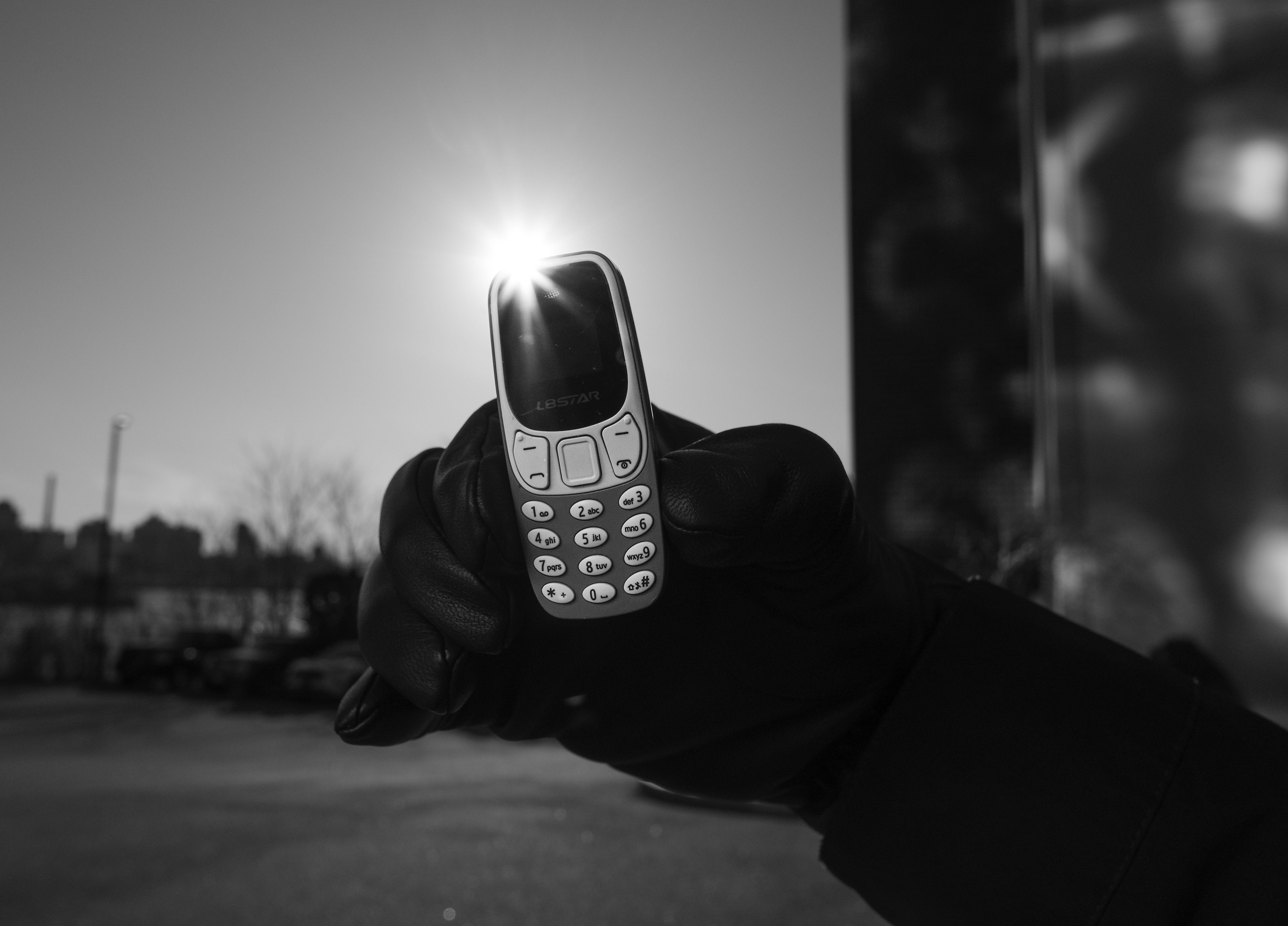
At the turn of the millennium the powerful made us a promise: modern technology would usher in a new era of progress. The president spoke of liberty spreading by cell phone, and the internet’s father proclaimed its goal was to “serve humanity.” Then came the flood of fabulating internet entrepreneurs. Automating food delivery and company payroll was now on-par with solving world hunger. They closed the gap with words, with lies, what they called mission statements.
Up until 2016 ----- the year our planet’s bubbling psychosis broke through, when the first Algorithmic children touched down at college campuses like aliens ----- I shared in their optimism. Many of my most pleasant (and now nostalgic) arcs ran through the technology. It was Katria who gave me the first taste of one of life’s great fears on Facebook, on iChat, on A.I.M. And then there were our secret video calls which made me believe, beyond doubt, in the transcendent force of technology. I suddenly understood why Bill Clinton loved it. What was not to love? Charged up on human electrons, the early internet added a new digital layer onto experience, which enriched the physical plane. Technology was our servant. We were the masters.
Yet, through the intervening decades, these technologies have evolved into monstrous versions of their earlier incarnations. Devices of the recent past were tools with a singleness of purpose. Word processors, MP3 players, cameras, camcorders ----- they gave you a feeling of focus, mission, and possibility. Now they have coalesced into the iPhone, which sends you spinning like a schizophrenic top across a universe of information. In and out you go through spheres of calamity, humor, madness, fear, love, lust, envy, hate ----- all in a matter of seconds. The simple forms of social media ----- where the people decided what they wanted to see ----- have mutated into TikTok’s lurid vortex, Twitter’s poisonous asylum, Instagram’s narcissistic slot-machine mirror. These platforms are no longer within our control. With our unblinking attention we sustain them, the Algorithm’s fish hook so deep in our brains that we’ve forgotten it’s there. For all the hypothesizing about neuro-chips, there is relatively little acknowledgement that the corporations have already installed modules in our minds. They have succeeded telekinetically. The red itch that runs on a timer, that prickle is a command to fork over money. It’s time for milking! and a million glazed eyeballs stare into fluorescent screens from parks in Calcutta to hovels in West Virginia.
We are already living in a minor dystopia, seething with an anxious soma. Though many of the elements are similar, it is not identical to the dystopias we were promised. That should be expected. The vivid visions themselves make those realms less likely to pass. Instead we have our world, where everyone is infected with a halfway addiction, smuggled into culture, normalized by society. Yet I fear the halfway addiction more than the full-blooded one. The supernovic addiction tells you exactly what you are risking and what you have to gain; it afflicts only a small percentage of the population. Conversely, the halfway addiction burdens everyone. It becomes insidious, a seemingly mild virus with an epochal incubation period. It hums on in the background. Then you hit seventy and suddenly you realize that instead of trying to develop the best part of yourself and give it back to the world ----- in some small or big way ----- you’ve splintered your imagination and you’ve squandered your time.
The Algorithm that rules us ----- that determines who we marry, the places we visit, the politicians we vote for, the worldviews we adopt ----- has replaced the mystical soul of the universe, what many used to call God. But this Algorithm is a cold and nihilistic God. It does not care about our spirits, our dreams, our ambitions, our peace, our happiness. It is not a God in tune with the universe’s sacred intergalactic thread, but a slave-God controlled by men and women with an unimaginable hunger for power, by rapacious investors who are amoral in their financing, by the excesses of a poorly-regulated capitalistic system. They’ve discovered the alchemy of converting attention into cash and cash into rewards for geniuses who use their intelligence to deceive us evermore successfully. They make us pay without ever asking us to open our wallets, knowing doing so would require a conscious consent which no one would give. And so, without realizing it, we pay with our minds and our time. We pay with our lives.
What are we receiving in return? The once-great United States is looking more and more like a battered beast; its shining bronze armor breaking off into shards, revealing the colossal staggering ape underneath. The nation is suffering from malaise, anxiety, depression, isolation, separation ----- a techno-nihilism that has stripped even the young of hope and heroes. We have lost the ability to diligently read, to vividly imagine, to empathize with once-remote people separated by mind, time, space, philosophy, race, gender, and social class.
Our reaction to such a loss has been a shrug of the shoulders. We are content to spend fifteen hours a week on evanescent podcasts and zero hours per lifetime on Homer, Shakespeare, and Dostoevsky. We have accepted trading the depth of a Wilde novel for the obscenity of a Clavicular stream; the clarity of Didion’s sentences for the distorted reality of Kardashian’s “stories”; the masculine spirit of Hemingway for the vulgar fraudulence of Tate. We have accepted trading silence for noise, earned secrets for faceless performance, mental peace for ever-present apocalypse, shared facts for shattered delusions.
But I did not go back to the dumb phone out of social responsibility. I went back to the dumb phone to save myself.
Last summer I dreamt of one day learning to write as well as my heroes. Of course the hero is nothing more than a myth, an unreachable standard, a reminder of what is possible. The hero is an embodied symbol of your highest potential. All of my heroes came of age in the twentieth century when novels and essays still held the promise of fame, status, money ----- even fortune. Why commit oneself to this art when all that is now off the table?
Writing gives the individual the opportunity to determine his perspective and discover his voice with minimal external influence. It requires that he understands other people, becomes a keen observer, and reads a hell of a lot of books. They can keep taking away all the external rewards ----- OpenAI and Anthropic can keep marauding ----- and still I will write because writing helps me master the highest art of all: the art of living. It is nothing more than an aid for discovering oneself, a proxy for living a better life.
I figured that if I ever wanted to approach my potential then I’d have to start living a little like my idols. It is not a coincidence that none grew up in the iPhone age. If great art is downstream of a heightened consciousness, then it is not surprising that the dwindling attention spans of the over-stimulated generations have delivered us a paucity of novelists, filmmakers, and painters on the scale of Fitzgerald, Kubrick, Dalí. If the goddess of silence is the wellspring of creativity, then it is not possible to reach one’s highest possibility with a lousy mind.
For many years I’d experimented with a multitude of iPhone modifications to try to break my halfway addiction. I started using grayscale, committed to Airplane Mode for eight hours a day, enforced all sorts of parental controls against myself. Inevitably, within a week, the grayscale would come off. Airplane Mode would end five minutes earlier each day. Finally, owing to a lack of amnesia, I’d break through all the locks I’d set. Then I would unravel deliciously. In a dopaminergic delirium I would re-install Safari, Facebook, Instagram, Twitter, Snapchat, Vine, YouTube, Gmail, Apple News ----- anywhere I could swipe up to reload, anywhere that rained new information down from space, anywhere I could gorge myself in an erotic burst of neurotic activity. I would swipe around and scroll like I was going to die tomorrow. For my final feast I preferred a gallon-tub of popcorn to ambrosia. I scarfed it down like I was starving; it refilled every time I neared the bottom.
The only way out, I realized, was to go back to the dumb phone. Since then it has been noted, praised, and admired, as if it is an Olympian feat, some thirteen thousand times a day. People have the wrong idea. It is not difficult to maintain. I did not even throw away my iPhone. During the week it remains off in my apartment while the dumb phone goes everywhere with me. On the weekends I use it to play music and get around. As soon as I take it out the people who praised me begin their criticism. They call me a fraud. They call me an addict. I love it when they call me a fraud. I love it when they call me an addict. My only wish is that they’d go further. I wish they’d remove the smartphone from my hands, join it with theirs, toss them both over the city’s buildings and into the sink.
Since making the switch to the dumb phone, no ecstasy has been delivered unto me. I have not yet escaped the cycle of death and rebirth. On the subway I do not fall into blissful states liberated from time. I am yet to experience a reverie in which I come to understand the creation of the pyramids, the musicality of Henry Miller’s prose, the brilliance of Chekhov’s construction. I have not yet produced a great novel. It is still infrequent for me to write a worthy short story.
But I am free. Every morning I write for two hours without distraction. Commuting to and from work, I give my mind the opportunity to rest. Once again I have fallen in love with the physical world. I enjoy watching the mannerisms of people and listening to the variety of their conversations. I hear the birds more often and pick up on the subtleties of the subway screeching. I have discovered innumerable new notes in song, prose, and poetry. My imagination is sharpening. Flannery O’Connor’s scenes are becoming more vivid. I have all but lost my interest in screens. My primary form of entertainment is now literature. I am reading like a madman ----- The Iliad, King Lear, The Brothers Karamazov ----- everything I never had time for. When I get home from work I read The Economist or County Highway while eating a plum. After ten years of scratching, the corporations’ red itch is nearly gone.
I’m sure that there are many other answers to one of the great wars of our time. I do not know about them. All I know is the dumb phone. It is tactile, simple; it has the Snake game that I played as a kid. It forces either a telegraphic style of written communication or a phone call ----- I luv them both. The dumb phone does not have a city map, so I have started developing my own. But my mental map is still limited, and so I frequent one or two bars where I know friends will eventually turn up. I am experiencing what my parents knew as a neighborhood haunt.
Our generation’s first revolution may not be in the style of mass protest. It may instead be a spiritual re-orientation away from technology and towards romance, wonder, peace, love, spontaneity, and beauty. Technology detoxes are not sufficient to break the global halfway addiction. The spirit must change. From this shift the logistical questions will answer themselves, in a manner that resonates with each individual. At some point soon we must realize the ruse, stand up to the heist. We cannot keep shrugging our shoulders. If not now then when, exactly, will we resist the pollutant Algorithm? When exactly will we have our renaissance? When exactly will we master the art of living?
This is a piece from the Spring ’26 print edition. Pre-orders available now. Party in New York on April 23rd.
preach it and amen
Algorithms are permeating human existence, expanding into domains that used to be wholly presided over by human choice and judgment. They are rapidly fusing with the means by which human culture is made. So in the end we'll be asking: to whom does the culture belong? Is it going to be human culture or algorithmic culture? At what point can you separate them, and when does the scale tip? In other words, when does culture stop being primarily human-authored and become system-shaped? And let's not forget that this new system has human proprietors.