

Emily Wilson, the Translator of "The Odyssey," on How Nolan Used Her Material
A dispatch from an event in New York City


About Us: Non Grata is a print magazine and online publication aiming to revitalize literature and give it back to the people. Print offerings are available on our website. Digital subscriptions (both free and paid) are available via Substack. For those of you in New York, we have a party coming up on August 1st (RSVP here).
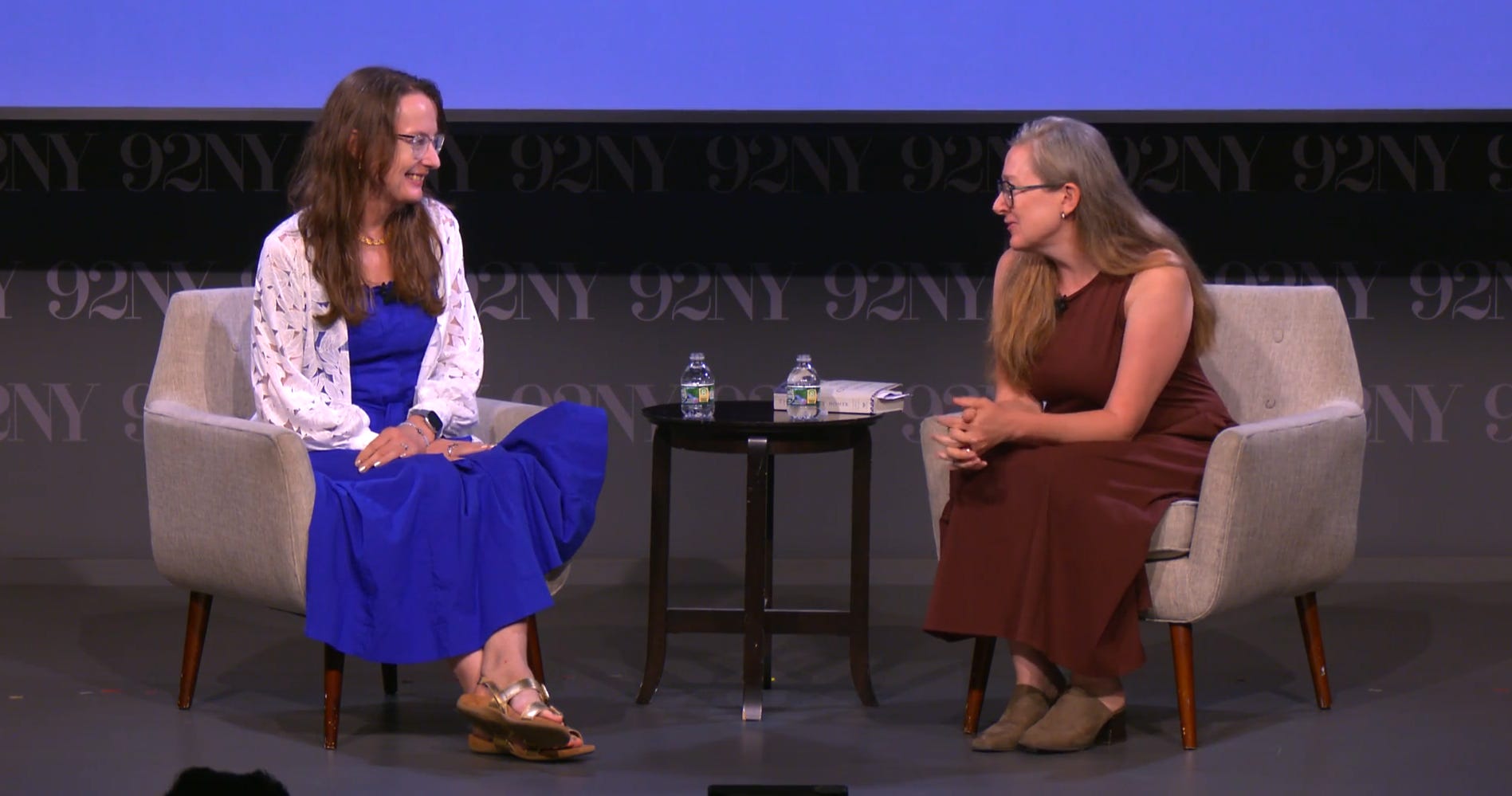
On July 16th, I walked through the Upper East Side under apocalypse-orange skies covered in smog – “Odyssean weather”, someone would call it later that night – to attend a talk at 92nd St Y: “Emily Wilson with Sarah Ruhl: The Odyssey Onscreen.” Christopher Nolan’s adaptation uses as its primary source Wilson’s translation of the Odyssey, which can’t seem to leave my life.
Like most people, I stumbled through it as a freshman in high school, speeding towards the end, unable to resist the pull of bloodthirsty revenge. I then enrolled in my high school’s Ancient Greek program and spent my senior year translating it into English. At the end of that year, I was asked by a skeptical Classics professor to translate Odysseus’ plunging of a burning stake into the sizzling eye of the Cyclops to a confused, grossed-out auditorium that viewed our contingent as a bit of a freakshow for choosing to dedicate ourselves to this subject. Now, I use Emily Wilson’s translation to teach it, and it is in this third exposure that I have grown the most attached.
Using Wilson’s translation for a classroom of younger readers feels like a no-brainer. While still keeping its poetry, her Odyssey is known to be more contemporary than some of the others used in curriculums or the ones I had read in school. Her translation is worth reading alone for its one-hundred page introduction, which doesn’t only teach themes and context, but also uses her subjective interpretation of the material as a lens to read the story through.
Wilson calls attention to certain ambiguities that make for a more interesting reading, such as the doubt that Odysseus truly ever will be able to restore the idea of “home,” or if it is even in his nature as a soldier and traveler to want to stay grounded, restrained to one place. She has a section titled “Hated Odysseus,” dedicated to his rage and the suffering he causes to others, including the crew he leads. Wilson suggests the possibility of treating Odysseus as a war veteran suffering from PTSD: “He’s moody, prone to weeping, often withdrawn, and liable to sudden fits of aggression,” questioning his ability to solve conflict without using brute violence. I was interested to see what Wilson thought about the movie in regards to her interpretation of Odysseus in this way. The event’s description online included the following questions:
● What can a story about travelers and the aftermath of war tell us about our own world in an era of mass migration, driven by military and political conflict?
● What can this epic of a “complicated man” reveal to us about contemporary masculinity and violence?
● In a nation rooted in myths of rugged individualism and sacred homeland, how does The Odyssey hold up a mirror to American life?
Although Wilson would touch on all these questions in conversation, adjacently if not directly, she spent most time on the topic of war in the Odyssey, and the different ways that Nolan and Homer present Odysseus’ feelings on it.
Before discussing the film, the conversation found its way to one of Wilson’s more controversial choices from the Odyssey – her translation of the opening lines, and in particular, the word πολύτροπος, “polytropos.” Wilson translates this word into “complicated” to describe Odysseus. (On the “contact me” page on Emily Wilson’s website, there is a “misogynistic trolls” button for particularly patriarchal fans who would like to voice their outrage.) Fagles translates this word as “man of twists and turns,” while Fitzgerald translates it as “skilled in all ways of contending.” Wilson said that she wanted to open up, immediately, the possibility that this man may not have been heroic, or at the least, ambivalent. Ambivalence in a hero, according to her, was more tolerated by the Greeks than it is by modern Hollywood. Part of Nolan’s challenge, Wilson said, was to present an ambivalent character as one American audiences could root for. The two then started discussing the film.
Ruhl: But it seemed to me that the movie was very much an anti-war movie, and about the notion that Odysseus is coming back from a war, and then he finds a war in his household. He finds a war sort of in himself. In the Nolan version, he’s telling the story. Odysseus is telling the story to Calypso, which is a change from the text, but it’s kind of a memory of what happened to him in war. What do you think about the film in terms of the notion of the Odyssey as an anti-war text?
Wilson: The film has these flashbacks to the Trojan War. I’m not sure if I see it as an entirely anti-war film, but it certainly presents us with an Odysseus who feels very bad about certain things that he’s done in war and is struggling to process them in a very, I would say very modern psychiatrized way. And he’s struggling to process them and needs drugs to do so for help with his recovery. And he seems to feel bad about being a warrior, and we never get to see him actually doing much warrioring, which I thought in a way was a bit of a shame.
Wilson makes an important distinction between PTSD and regret, staying consistent to her introduction of her translation, which suggests that Odysseus suffers from PTSD but at no point argues that he is remorseful for his killing. It is notable that directly after the sacking of Troy in the epic, Odysseus’ first stops are at other cities, where he and his crew steal the wives of the men they murder.
Nolan’s adaptation of the epic hinges on a guilt that Wilson says isn’t there. In the emotional climax of the film, in a conversation between Penelope and the disguised Odysseus, Odysseus reveals to Penelope that it is his guilt that has kept him from returning home all these years–that he feared, with his invention of the Trojan Horse and the sack of Troy, that he had ruined the fabric of Greek society through the ultimate violation of xenia, which is referred to in the film as “Zeus’ Law.” Ruhl mentioned in her question an interesting departure from the text that the film employs: Odysseus narrates his flashback to Calypso rather than to the Phaeacians in the land of Scheria. In the film, he narrates his story as a way of trying to remember himself. In the epic, he narrates his story in order to be a good guest and follow the rules of xenia, but also to gain the Phaeacians’ pity, who can help him get home.
Towards the end of the discussion, Ruhl returned to the topic of war, asking Wilson directly: “In the epic, do you think Odysseus felt bad about the war?” Wilson replied by bringing our attention to the episode of the Phaeacians. At the Kingdom of the Phaeacians, which is where Odysseus washes ashore after finally getting freed from Calypso’s island, he charms his hosts with his politeness as a guest. During dinner, Emily Wilson says that Odysseus asks to hear the poet Demodocus sing the story of his own “greatest Oppenheimer technological success,” the Trojan Horse. When he hears the story, he cannot contain his weeping. But Wilson said that although you might expect his crying to be a “yay me weeping,” his tears are described in a “beautifully cinematic, Homeric simile” as the crying of a woman who watches her husband get stricken down, knowing that she is going to be sold into slavery, and who by the end of the simile, sees that her husband is dead. She says,
That’s how Odysseus is crying. So is he crying because he feels bad about all the women who’ve been raped and enslaved, and all the men that he’s killed? Or is he crying because he feels trapped in Scheria and out of place, not getting to sack more cities? I think you can hear it both ways, right? There’s definitely pain, but is it pain that he’s feeling guilty because he wasn’t very nice? I’m not sure. I feel like that’s a little bit anachronistic.
When it comes to this question about Odysseus’ guilt about the Trojan War, I think it’s important to look at the only other time Odysseus hears the song of the Trojan War: the sirens’ song. Odysseus’ men cover their ears in bee’s wax and tie their leader to the mast so he can listen to his siren song:
‘Odysseus! Come here! You are well-known from many stories! Glory of the Greeks! Now stop your ship and listen to our voices. All those who pass this way hear honeyed song, poured from our mouths. The music brings them joy, and they go on their way with greater knowledge, since we know everything the Greeks and Trojans suffered in Troy, by gods’ will; and we know whatever happens anywhere on earth.’
‘Their song was so melodious, I longed to listen more. I told my men to free me.’
The appeal of the sirens in Homer isn’t that they sing what you want to hear, it’s that they offer knowledge. Odysseus wants to hear the song of the Trojan Horse because he wants to understand how he will be remembered in history. Their story is a confirmation of his heroism and success. In his world, this is currency; it is the fame and reputation that Odysseus, like many Greek heroes, wants.
Christopher Nolan’s Odysseus rarely shows his heroic qualities and is instead defined by his guilt. This adapted focus on internal conflict hinges on his portrayal of the sirens’ song, where we see the bipolar effects of seduction and horror, yearning and agony, on Odysseus’ sunburnt face. We purposefully can’t hear what Odysseus hears. When Eurylochus asks him, he explains:
It’s all the things you wanted it to be, and then, all the things you wished you didn’t wish for. It’s an itch – a delicious itch you don’t want to scratch. That delicious itch becomes unbearable because you can’t scratch it. What you most want is what you most can’t have. And what you most can’t have, is what you already had and lost . The song of all the promises I failed to keep.
Is this where Odysseus’ pride turns to guilt, or where he realizes that restoring home is not possible? Is this, as it is in the epic, the first time he’s heard an account of Troy? We are purposefully kept in the dark. Perhaps Odysseus’ sobbing at the sirens’ song is Nolan’s deliberate conflation of this event with his’ crying at the same song in the palace of the Phaeacians. Regardless, he uses this moment to enact his most fundamental change of Odysseus, through whom he can present the Odyssey as an anti-war tale. Wilson saw this omission of the Phaeacians as a missed opportunity to enjoy Odysseus’ talent for linguistic cunning.
Ruhl asked Wilson if she would recite the epic’s opening lines. Wilson took off her sweater and stood from her chair, straightening her posture, and with some formulaic, minor hand movements, delivered the lines… in Ancient Greek. I was surprised that she chose the Greek, for some reason assuming that Ruhl was asking her to read from her English translation. Perhaps I wasn’t the only one surprised, because after a couple more minutes of discussion, Ruhl asked Wilson if she would stand again and deliver them in English, offering her copy of the Odyssey for Wilson to read off. Wilson quickly refused, replying that she’d rather recite it from memory: “It’s more rhapsodic this way.”
It was at that moment that I recognized beneath her career as a writer, translator, and professor, was a relatable, somewhat irrational curiosity to this ancient world, one that is imaginative and almost always born from some exposure to Greek mythology we have as children.
As I watched her, I was transported to my ninth grade English class in Catholic high school, where I had to recite twenty-four chosen lines from The Odyssey from memory. I chose to recite Odysseus’ stringing of the bow, mistakenly thinking those were the lines in which he actually murders the suitors with his arrows. Then, once a year in Greek class for the next three years, in a tradition called “Declamation Day,” I’d have to do the same thing, except in Ancient Greek.
As she recited her lines, the humor of it all hit me, as it sometimes does, snapping me out of Ancient Greece. I thought of myself as a high schooler, in my blue blazer, nervously answering questions from Classics professors about nostos; Wilson sweating on stage, reciting from memory, in a dead language, a made-up story, like our lives depended on it. All this serious erudition that spawns, ultimately, from a mythology centered around gods and goddesses who were born from their fathers’ head.
It’s funny that I approached the movie defending Nolan’s right to be creative and take risks because when I watched it, I found myself like Emily Wilson: disappointed in the dozens of things I would’ve done differently. The conversation made me think about her role as a translator, where there is a strange, unspecified gray area in which she is allowed to shape the story to her interpretation but only to a certain extent; she must find those moments in the epic that are ripe in ambiguity.
When asked by an audience member if she felt compelled to “give agency to characters [such as Penelope] who lacked it,” she replied, almost viscerally, “I’m not trying to liberate a fictional character. That, to me, seems strange.” What are the limits in adaptation when it comes to film? Ultimately, that the Odyssey is generating this much discussion around its message is a testament to why it sustains – that it is in its fluid nature and history to be manipulated, toyed with, and reimagined. Nolan’s film has the potential to impact the public consciousness about the story. Will it establish its own chapter in the oral history of the Odyssey? Whether or not you think he has transformed the story in the spirit of Homer will decide if it deserves to.
 | A guest post by
|
With all due respect, Wilson’s translation is quite unfaithful to the original text, and I don’t think it’s a good choice for you class (the fact that she recited the original poem in Greek speaks for itself). This is mainly because she brought her own agenda to her translation (the fact that she feels compelled to call her critics on her website “misogynistic trolls” shows how immature and unprofessional she can be). Here is an actual quote from Wilson’s introduction:
“The gendered metaphor of the “faithful” translation, whose worth is always secondary to that of a male-authored original, acquires a particular edge in the context of a translation by a woman of The Odyssey, a poem that is deeply invested in female fidelity and male dominance.”
She also admits to using contemporary, anachronistic language (while dismissing such accusations) and stating her goal to “question” the original poem:
“Because The Odyssey has become such a foundational text in our educational system and in our imagination of Western history, I believe it is particularly important for the translator to think through and tease out its values, and to allow the reader to see the cracks and fissures in its constructed fantasy. I see this process not as a denial or abandonment of the original text, but as a way to pay deep attention to the original, most especially in the moments when it may contradict itself.”
The job of a translator is simply to render the text from the source language to the target language; any interpretive work is deciding how to make the text sound natural in the target language. Wilson decided to make a political statement out of her translation, so it cannot be called a faithful one in good faith.
Fellow classicist Richard Whitaker actually wrote a paper examining Wilson’s translation choices and found that she has made a considerable amount of unforgivable translation errors, some of them ideological, meant to paint Odysseus and Thelemachus in a bad light and Polyphemus and the suitors in a positive light: https://casa-kvsa.org.za/legacy/AC63-Whitaker-18DEC2019.pdf
I personally recommend the more accurate translation by Daniel Mendelsohn.