

Legends of Zelda: The Truth About F. Scott Fitzgerald
In defense of one humanity's greatest writers


The repeated claim that Zelda was the source of his F. Scott Fitzgerald’s genius should upset anyone that cares about literature, truth, and justice. It is nothing more than a conspiracy theory. Thankfully, A. A. Kostas is here to set the record straight. May this be the end of discrediting the F. Scott Fitzgerald, one of humanity’s greatest writers.
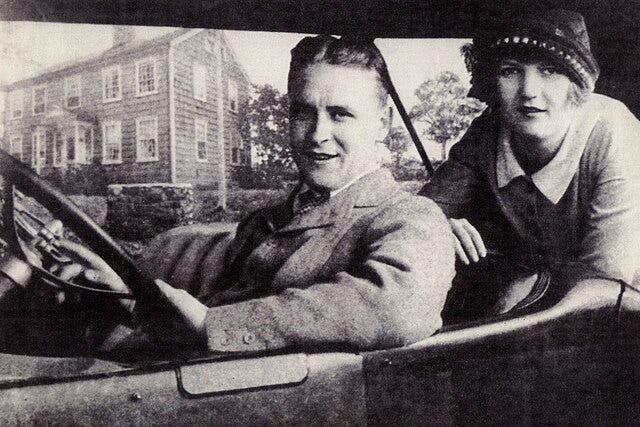
I.
Ladies and gentlemen of the jury — before the defense begins, I propose two axioms regarding the dangers of literary myth-making which we should all be able to agree upon:
Writing autofiction inherently invites myth-making.
You cannot control a myth. Once an author’s life becomes myth, it no longer belongs to him or her, but to the people.
If these are acceptable, perhaps we can add a slightly more controversial maxim:
Most attempts to ‘counter’ a myth result in the creation of a new myth, not a distillation of factual truth.
In the past two hundred years, no country has been more invested in elevating authors to the strata of myth than the United States of America. And in the past fifty years, no country has been more invested in tearing down those very myths.
If the 20th century will forever be remembered as the American Century — when the United States transcended the category of nation to become the world’s premier empire, exporting its high and low culture across the globe — then one couple stands as the king and queen of that dawning golden age: Francis Scott Fitzgerald and Zelda Sayre.
II.
My adolescence happened to coincide with the rise of a new kind of alternative-history game, very popular at schools, universities, newspapers, magazines, etc., and supercharged by social media. Perhaps you know the game. It’s called, ‘He Wasn’t Actually a Genius’, and the rules are very simple: You pick a historically admired man and point out that he had a talented (or at least vivacious) wife, and then posit that his genius was not singular but more likely the result of an intellectual partnership with said wife. So far, not that controversial. However, you cannot win this game by staying within the realms of reason; instead you must fervently argue that the man had limited talent, that he ‘stole’ the work of his wife, or else that she was an uncredited equal partner due to pervasive sexism and brutishness. And thus, you destroy the myth of the lone male genius.
Of course, this game is pointing at a sometimes true aspect of domestic relationships. It cannot be denied that Mileva Marić was a better student and more organized physician and mathematician than Albert Einstein, or that John Stuart Mill repeatedly stated that his wife Harriet should have been listed as a ‘joint author’ on some of his great philosophical treatises. And in the realm of famous littérateurs, Anna Funder’s recent book Wifedom sheds light on how closely involved Eileen Blair was in the development of her husband’s novels Animal Farm and 1984. Whether a spouse’s assistance in discussing, debating, developing, typing, or editing a manuscript should count as ‘co-authorship’ or give rise to claims of ‘uncredited plagiarism’ is a nuanced matter. What about non-marital editing relationships? Should we delete Raymond Carver’s name from his short story collections in favor of Gordon Lish? What about Thomas Wolfe and Maxwell Perkins? Or Harper Lee’s To Kill a Mockingbird, which famously took editor Tay Hohoff two-and-a-half years to extract from the originally bloated manuscript?
This nuance, however, was nowhere to be found in the heady days of the early 21st Century, when I was making my way through secondary school. Instead, as I first dipped my toes into the fiction of Scott Fitzgerald, I was told with much gusto that he ‘wasn’t that great a writer,’ that he ‘stole most of the good stuff from his wife Zelda,’ and that she was the ‘true talent.’ It was also implied that this unfair treatment was what drove Zelda insane, with a jealous Scott committing her to an insane asylum so he could cash in on the books filled with writing stolen from his estranged, glamorous, brilliant wife.
This was the new myth: that behind every talented man crouched an even more talented, but cruelly subjugated, woman.
III.
I spent the first three years of my legal career representing individual litigants in unlawful termination cases, battling their former employers for a bit of cash. My clients were an even 50/50 split between individuals who had truly been wronged, and those who deserved to be fired but couldn’t accept it without a fight. The right person didn’t win every time. Sometimes the litigant who deserved to be fired was able to win on a technicality. Sometimes they were just more winsome and likable in the courtroom. And sometimes the person who you knew was innocent of whatever the company claimed, was so ornery and unlikeable in front of the judge that they had no hope of winning. This all goes to say that I know a thing or two about how to win a case despite defending an unlikeable person.
If there is any real competition between Scott and Zelda, it’s not about their literary abilities (more on that later) but who you should feel more pity and revulsion toward. They were both raging alcoholics that were commonly kicked out of hotels for disturbing other guests (as well as for destruction of property), that got into trouble with fire brigades and law enforcement for making false reports, that once boiled guests’ expensive watches in a pot of tomato soup as a joke. Zelda also had a penchant for throwing herself off cliffs and down staircases, setting things on fire and overdosing on pills, while Scott commonly drank himself to blackout and attempted suicide on multiple occasions. In essence, the Fitzgeralds perfected the attention-seeking, self-destructive, tabloid behavior of young people thrust into the limelight, which was set to define the following century.
However, the central question is not the character or morals of the Fitzgeralds’, but (a) the quality of Scott’s writing, and (b) whether or not Zelda was the genius behind his novels and stories. How much truth lies behind the myth and counter-myth? Does Scott Fitzgerald deserve to be called the first great American writer of the first great American Century?
IV.
Hemingway certainly thought so. One of our best primary sources for understanding the nature of Scott and Zelda’s relationship from a literary perspective is A Moveable Feast, Hemingway’s swan song, completed just before he died in 1961 and published posthumously in 1964.
Hemingway, who dolled out compliments sparingly, was in awe of Scott’s raw talent when they first met in 1925. Scott had just published his third, and best, novel, The Great Gatsby, and any personal foibles that Scott demonstrated (there were many) could be overlooked by the usually impatient Hemingway. He regularly met up with Scott in Paris to discuss their respective writing, agreed to travel with him through the French countryside to retrieve a car that Zelda had impulsively left behind in Lyon, and the two young families spent holidays together, despite the strong reservations both Hemingway and his wife Hadley maintained about Zelda’s non-stop party lifestyle.
Hemingway’s recurring frustration with Scott was how he let Zelda affect his craft, how the dazzling genius emergent in This Side of Paradise (released when Scott was just twenty-four years old and before he married Zelda, who agreed to their union only after the book was published), was beaten into something self-doubting and drab by his constant ‘whoring’ — Hemingway’s term for Scott’s habit of rewriting short stories to contain dramatic twists and romances and happy endings so slick magazines would publish them — in order to provide for the lifestyle Zelda believed they deserved. As it stands, if Zelda has any real claim to being involved with Scott’s writing, it’s through her habit of reviewing his ‘far too literary’ drafts and suggesting where they might be changed to appeal to the mass market readers of The Saturday Evening Post and Collier’s Weekly and Esquire, in addition to contributing a few quotes and pages to his multi-thousand-word oeuvre.
V.
For all the modern griping about autofiction, it can be extremely entertaining to read when well done. Scott struck gold with This Side of Paradise, through which he learned the power of mythologizing oneself. After that he couldn’t seem to stop doing it, no matter how sad and desperate his life became.
When you read Scott’s novels and many of his short stories you can’t help but feel the thrill of recognizing the real-life people he has given new aliases, and seeing how he shapes their brokenness into something with a deeper meaning. It works because he does more than tell us of toxic relationships and the agony and ecstasy of spiralling out of control; he places the reader inside the heart and mind of people like himself — men and women who aren’t ‘bad’ per se, who have a sense of morality, but can’t stop themselves from trying to manipulate people and grasp at things they cannot have. Scott consistently risks readers criticizing his own nature by giving us an interior view of his pseudo-biographical characters’ moral failings.
For example: in “Babylon Revisited,” a 1931 short story, we tag along with a Scott stand-in who is trying to recover custody of his daughter from his deceased wife’s relatives. Despite being a washed-up alcoholic, he has his wits about him, and he knows to play the situation delicately in order to get what he wants:
He knew that now he would have to take a beating. It would last an hour or two hours, and it would be difficult, but if he modulated his inevitable resentment to the chastened attitude of the reformed sinner, he might win his point in the end.
The crux of the story is the protagonist, Charlie, interacting with his sister-in-law, trying to convince her to relinquish her guardianship over his daughter, even as she blames Charlie for her sister’s death. And Scott freely shows us how disingenuous Charlie is, even if his desired outcome is not necessarily a bad one. He’s attuned to human emotions and he is doing his best to play them for his own purposes, but without descending into cartoonish psychopathy. At one point Charlie partially loses control, swears at his sister-in-law, and has to back off. But in doing so he leaves room for her to pounce and she overreacts, causing her own husband to take Charlie’s side, causing the narrator no small amount of glee:
But [Charlie] pulled his temper down out of his face and shut it up inside him; he had won a point, for Lincoln realized the absurdity of Marion’s remark and asked her lightly since when she had objected to the word “damn.”
This is a good short story and Scott is a good writer, but his work would be less interesting, less purely entertaining, if you didn’t know how closely his fiction dovetails with his own tragic life. Scott seemed to relish in writing about his life through the thin veil of fiction, raising him and Zelda and their cohort up to the realm of gods, while they carried on like Greek gods and goddesses — cavorting in endless bacchanals, collapsing night after night from drink, sleeping around, jumping onto the hoods of cars, literally swinging from hotel chandeliers. They were momentarily Gods of their own myth, but the myth quickly became a Titan, which began to swallow them whole. As time went on, both Scott and Zelda became suicidal — Zelda often threatened suicide in public settings as an argument-ender — and they severely mistreated their child, Frances ‘Scottie,’ while constantly mistreating each other. Through it all, Scott couldn’t stop writing about their lives in the guise of fiction, couldn’t stop trying to spin the muddy straw into gold.
As I said at the start, nothing invites myth-making about an author’s life like a work of autofiction. The only safe way to go about it is the Elena Ferrante method, total anonymity. But that was never Scott’s style, leading to the instant birth of the Fitzgerald myth. However, Scott himself admitted to editor Malcolm Cowley, another member of the Lost Generation, that blurring the line between truth and fiction came with several burdens:
Sometimes I don’t know whether I’m real or whether I’m a character in one of my own novels.
The trouble for Scott and Zelda is that self-mythologizing initially gave them a taste of the high life — all the attention and riches available for a young novelist and his exciting young wife, both willing to become the story — before it all came crashing down.
It should be recognized that Scott essentially invented the term the ‘Jazz Age’ and used it liberally, as an ongoing act of conscious mythologizing, placing him and Zelda as crown prince and princess of a kingdom that only ephemerally existed. The adolescent, freewheeling, heavy-drinking life of pre-WW1 college students, preserved forever in Scott’s mind as the best years of his life, was a representation of the Fitzgeralds’ monied decadence, not a true reflection of the ’20s and ’30s. In reality, Scott’s novels are at their heart Edwardian, with ghosts and specters and hauntings, and with characters wishing to return to the past due to conflicts in their social mores. Scott may have used the ‘Jazz Age’ as his setting, but even he knew it was a fantasy.
On the topic of myth, it’s not surprising that as a practiced mythologizer Scott would become so entranced by the real-life Max Gerlach, a millionaire bootlegging fabulist that he was able to sculpt his best work into a meditation on the nature of myth itself. The Great Gatsby is, at one level, an outflow of game recognizing game. The forever insecure Scott — always fretting about his poorer upbringing and lack of class credentials, trying to appear wealthier and more accomplished than he was — peering across the cocktail party at the ebullient Gerlach, confidently lying about his nationality and the providence of his riches. Gerlach achieved what Scott never quite managed — a fully embodied myth, a man forcefully transcending any unhelpful or unsavory elements of his origins and upbringing to become whatever he desired.
VI.
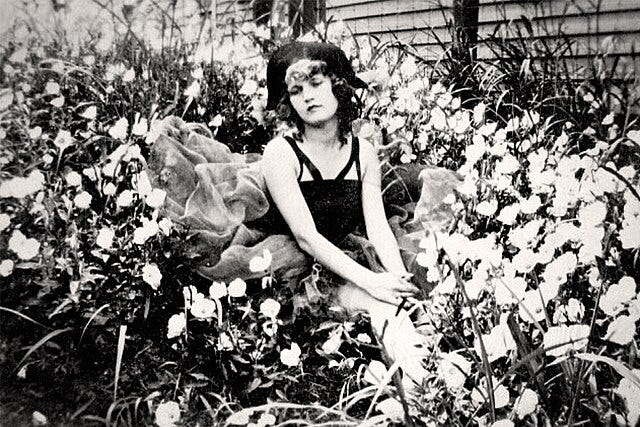
Zelda, Zelda, Zelda. A woman who was the definition of a self-determined and raucous ‘flapper,’ a term she popularized alongside Scott’s ‘Jazz Age,’ writing in 1922 that:
“[the flapper] flirted because it was fun to flirt and wore a one-piece bathing suit because she had a good figure… she was conscious that the things she did were the things she had always wanted to do.”
Somehow she went beyond myth and became an archetype, ‘the flapper’ remarkably prescient for our age of influencers and celebrities and politicians willing to debase themselves in a million ways for attention, but unable to get out of their own way once they have it. Incredibly self-destructive, wretchedly self-obsessed, narcissistic and shallow, but rewarded by a society entranced with car crashes and natural disasters. Zelda Fitzgerald was intelligent, there’s no doubt about it, but she was intelligent in the way Paris Hilton is intelligent, or in the way Donald Trump is intelligent. And neither of them are, of course, good writers.
I propose a reasonable bar for the spouses of great writers to clear before we credit them as having contributed to the great writer’s genius: (1) they contribute a non-insignificant amount of new material to the writer’s body of work, or (2) they significantly edit or rewrite the novels most lauded by critics and the general public. And (3) they really should have demonstrated some writing talent of their own, independent of their more famous spouse.
Unfortunately for Zelda, she doesn’t pass any of these tests. All the arguments about Zelda’s supposed ‘stolen genius’ largely hinge on Scott’s use of Zelda’s diary entries and letters in several of his novels. But, importantly, this practice of wholesale reproduction was used sparingly — in the order of, at most, a few sentences in the course of a novel — and Zelda wasn’t the only target. This Side of Paradise reprints entire letters Scott himself sent to both Zelda and his priest, Father Sigourney Fay, as well as their responses, despite being categorized as fiction. Of course every writer takes characters, passages, and dialogue from life, and even if one argues that Scott should have credited her for these sparse words, his colossal genius cannot be reduced to discrete sections of text pillaged from correspondence. It’s also telling that nobody, not even Zelda’s most ardent supporter Nancy Milford (who wrote the the foundational text of the pro-Zelda mythology, Zelda: A Biography, in 1970), has been able to show that Zelda contributed meaningfully to any of Scott’s best work — not to his two best novels The Great Gatsby or Tender is the Night, nor his best short stories: “Babylon Revisited”, “The Diamond as Big as the Ritz”, “Winter Dreams”, “The Rich Boy”, “Bernice Bobs Her Hair”, “Absolution”, “May Day”, or “Crazy Sunday”. By comparison, the stories with the most clear Zelda influence are trite pieces of fluff: “The Offshore Pirate”, “The Jelly-Bean”, “Our Own Movie Queen”, “The Original Follies Girl”, “A Millionaire’s Girl”, etc.
The real genius of Scott’s prose lies in the tone and voice that is entirely rooted in the anxious ego and belligerent id of his narrators and protagonists. We are let into the inner machinations of neurotic strivers and obsessives, jealous outsiders and secret-keepers, and the entire atmosphere of his novels bends around the gravitational pull of these men who are intelligent but insecure. Scott’s talent was in realizing protagonists didn’t have to be likable to be compelling, as long as they had a soft spot among the neuroses, as long as they were vulnerable. For Scott, so similar to many of his male characters, his vulnerability was always Zelda.
The fact that Zelda demanded Scott rewrite his stories to make the plots more interesting so they sold better, then demanded he come out partying all night instead of writing, so that his follow-up to The Great Gatsby took nine years to write instead of the customary two or three he had previously managed, should be evidence enough that Zelda did not care for the work of literature. She cared for the lifestyle of being attached to a successful writer.
If you still aren’t convinced, let’s compare two similar passages from the estranged couples’ twinned novels — Zelda’s Save Me the Waltz of 1932 (which, it should be noted, Scott first accused Zelda of plagiarizing from him, but then dropped those claims for fear of further upsetting her mental health, and then ultimately helped her get it published) and Scott’s 1934 Tender is the Night, his last complete work before his death at forty-four years of age. Both novels are set in the French Riviera and involve unhappy marriages and infidelities. Here is Zelda’s description of the locale:
The Riviera is a seductive place. The blare of the beaten blue and those white palaces shimmering under the heat accentuates things.
And here is Scott’s:
On the pleasant shore of the French Riviera, about half way between Marseilles and the Italian border, stands a large, proud, rose-colored hotel. Deferential palms cool its flushed façade, and before it stretches a short dazzling beach… The hotel and its bright tan prayer rug of a beach were one.
Scott’s description gives us a sense of what the exclusive and sacred space the Riviera represented for a certain class of people, with hints toward deference and pride and religious piety all bound up in a few short sentences. Whereas Zelda’s own description of the same location is juvenile, the sort of thing any teenager in a creative writing class could produce. She lifts up her dress to flash you with ‘seductive’ and then refuses to go any further by retreating to the generic ‘things.’
VII.
One of the other lessons I gained from being a trial lawyer: be careful of who you call as a witness. The most seemingly eager supporters can sometimes do more harm than good.
A Moveable Feast and much of Hemingway’s correspondence during the ’20s certainly paints Zelda in a negative light — she’s shallow, vain, constantly drunk, overly materialistic, casually cruel, and oftentimes insane. She clearly interferes with Scott’s writing, both in terms of not allowing him any time away from the nightlife and by bullying him on what to write and for which publications. The feminist scholars who have been pushing the ‘Zelda as the true genius’ idea since the ’70s sideline this evidence due to Hemingway’s obvious misogyny, but even if we attempt to correct for any gendered biases, Hemingway is not actually as helpful for Scott’s case as he may seem. Despite being fond of his friend and in awe of his talent, Hemingway inadvertently (or maybe advertently) paints Scott as weak, foppish — a nancy boy, to use the parlance of the time. This too becomes part of the Fitzgerald myth.
Take, for example, how Hemingway describes Scott when he believes he has fallen sick in a hotel on their drive back from Lyon, as Hemingway tries to pamper the childish Scott despite there being nothing wrong with him:
On this evening in the hotel I was delighted that he was being so calm. I had mixed the lemonade and whisky and given it to him with two aspirins and he had swallowed the aspirins without protest and with admirable calm and was sipping his drink. His eyes were open now and were looking far away. I was reading the crime on the inside of the paper and was quite happy, too happy it seemed.
‘You’re a cold one, aren’t you?’ Scott asked and looking at him I saw that I had been wrong in my prescription, if not in my diagnosis, and that the whisky was working against us.
‘How do you mean, Scott?’
‘You can sit there and read that dirty French rag of a paper and it doesn’t mean a thing to you that I am dying.’
‘Do you want me to call a doctor?’
‘No. I don’t want a dirty French provincial doctor.’
‘What do you want?’
‘I want my temperature taken. Then I want my clothes dried and for us to get on an express train for Paris and to go to the American hospital at Neuilly.’
‘Our clothes won’t be dry until morning and there aren’t any express trains,’ I said. ‘Why don’t you rest and have some dinner in bed?’
After this went on for a long time the waiter brought a thermometer.
After Hemingway messes about with the thermometer and tries to convince Scott that it is working properly and his temperature is normal, Scott demands that Hemingway use it on himself, which he does, after which Hemingway informs Scott that they have the same temperature (despite the mechanism not actually working):
Scott was a little suspicious so I asked if he wanted me to make another test.
‘No,’ he said. ‘We can be happy it cleared up so quickly. I’ve always had great recuperative power.’
This is all played for laughs, with great comic timing, but Scott then rushes off to call Zelda with claims that the two of them “have never slept away” from each other since they were married, which Hemingway points out can’t be true in the light of Zelda’s affairs which Scott has confided in him earlier that day. The version of Scott found in A Moveable Feast is consistently like this, self-defeating and foolish, and Hemingway can’t help but do what inwardly insecure but outwardly masculine men have been doing for millennia: he makes Scott his cuckold.
It’s strange that Hemingway was able to manage this, because in many ways Scott was the stronger writer, and Hemingway knew it. But to this day, Fitzgerald is far less esteemed by MFA students than their sacred ‘Papa,’ and that is partly due to the surviving mythos of Hemingway as the clear-eyed reporter of human facts vs. Scott as the romantic weakling and cuckold. When comparing their writing, I have to admit that I’m often inclined towards Scott’s romantic modernism over Hemingway’s minimalism. Take their scene descriptions in the first chapters of each of their third novels, The Great Gatsby and A Farewell to Arms, respectively:
The wind had blown off, leaving a loud bright night with wings beating in the trees and a persistent organ sound as the full bellows of the earth blew the frogs full of life. The silhouette of a moving cat wavered across the moonlight and turning my head to watch it I saw that I was not alone—fifty feet away a figure had emerged from the shadow of my neighbor’s mansion and was standing with his hands in his pockets regarding the silver pepper of the stars. Something in his leisurely movements and the secure position of his feet upon the lawn suggested that it was Mr. Gatsby himself, come out to determine what share was his of our local heavens.
and
In the late summer of that year we lived in a house in a village that looked across the river and the plain to the mountains. In the bed of the river there were pebbles and boulders, dry and white in the sun, and the water was clear and swiftly moving and blue in the channels. Troops went by the house and down the road and the dust they raised powdered the leaves of the trees. The trunks of the trees too were dusty and the leaves fell early that year and we saw the troops marching along the road and the dust rising and leaves, stirred by the breeze, falling and the soldiers marching and afterward the road bare and white except for the leaves.
Scott is clearly doing a lot more work in his paragraph, drawing us toward the lush atmospheric stage his main character is about to walk upon, compared with Hemingway’s dull and repetitive reportage. I am by no means calling Hemingway a bad writer(!), but I do think we lose something in jettisoning Scott’s romanticism for Hemingway’s dry style. I think one of the reasons this happened is due to the diverging myths surrounding the two men.
Scott and Hemingway’s Paris days among the Lost Generation are key to understanding how they would go on to be viewed by the reading public, as those brief years somehow entered the literary legendarium and formed a lens through which we view them both; but we should note that it is a legend shaped largely by Hemingway himself. In the mythic version of 1920s Paris, Scott is literally cuckolded by Zelda and figuratively cuckolded by Hemingway — he will always be the simpering, fussy loser to Hemingway’s clear-headed strongman. It doesn’t help Scott that there is a smack of truth about this. He was close in upbringing and temperament to his protagonists — Nick Carroway, Amory Blaine, Anthony Patch, and Dick Diver — neurotic and physically unassuming men, who are stuck in their own heads, always analyzing and worrying, always seeking to understand the social dynamics around them. This is why it was too easy for Zelda to yank Scott’s chain. For a period, she convinced Scott that his penis was too small to bring pleasure to a woman, which required Hemingway to inspect his friend’s member, and then take Scott on a tour of the Louvre’s classical statues to prove to him that he was normally endowed. (And in evidence against Hemingway’s supposedly raging misogyny, he also instructed Scott on the use of a pillow to achieve the right angle for pleasing his wife during copulation. Ernest Hemingway, ally of female pleasure.)
It also doesn’t help Scott’s myth that he ended his life as an alcoholic suffering from cardiac arrest in his lover’s shabby Californian apartment after a failed attempt at becoming a Hollywood screenwriter, while Hemingway was snatching marlin from his Cuban cruiser and smoking cigars with Castro, his shotgun and mouth still yet to meet for another twenty-one years.
VIII.
As both Henry Begler and Alexander Sorondo have recently pointed out, there is probably no literary character more relevant to our culture today than Patrick Bateman, the protagonist and narrator of Bret Easton Ellis’ 1991 transgressive novel American Psycho. The question arises: are Scott’s characters the progenitors of Bateman? If not, then why do so many of Scott’s leading men feel nearly psychopathic, trapped in their minds, obsessive toward people and interactions with them, inwardly observant of their own minds and thought processes but unable to reach out and truly connect with another human being, unable to give any other person access to that secret locked door buried in their selves? There is something of Patrick Bateman both Amory Blaine and Jay Gatsby: the obsession with wealth and status, with class dynamics and interpersonal slights, the focus on women and wishing to have some sort of romantic connection that never quite eventuates. But even in “Babylon Revisited,” there are hints of Bateman as a purely materialistic egregore of late ’80s capitalism. See the specificity and focus on the restaurants, the lingering regret, the sense of not existing, as Charlie moves through 1930s Paris:
Outside, the fire-red, gas-blue, ghost-green signs shone smokily through the tranquil rain. It was late afternoon and the streets were in movement; the bistros gleamed. At the corner of the Boulevard des Capucines he took a taxi. The Place de la Concorde moved by in pink majesty; they crossed the logical Seine, and Charlie felt the sudden provincial quality of the Left Bank.
Charlie directed his taxi to the Avenue de l’Opera, which was out of his way. But he wanted to see the blue hour spread over the magnificent façade, and imagine that the cab horns, playing endlessly the first few bars of La Plus que Lent, were the trumpets of the Second Empire. They were closing the iron grill in front of Brentano’s Book-store, and people were already at dinner behind the trim little bourgeois hedge of Duval’s. He had never eaten at a really cheap restaurant in Paris. Five-course dinner, four francs fifty, eighteen cents, wine included. For some odd reason he wished that he had.
As they rolled on to the Left Bank and he felt its sudden provincialism, he thought, “I spoiled this city for myself. I didn’t realize it, but the days came along one after another, and then two years were gone, and everything was gone, and I was gone.”
But as I have said before, this is also a reflection of Scott himself. His protagonists are never very far from his own nature. Which partially explains why Hemingway describes Scott as acting so oddly upon their first meeting, incessantly interviewing people about their habits, their social ethics, their sex lives. Why do they do things and do they feel what they do is wrong? It’s like an alien trying to understand the nuances of humanity’s social cues.
The episode Hemingway describes, of travelling with a neurotic and hypochondriac Scott — delusional about his own vitality while simultaneously being convinced of illnesses he doesn’t have — reveals the man to be a sadly comic character. Tragic in his self-deceit, but somewhat innocent and lovable in how he moves through the world, sympathetic because of how much he clearly doesn’t understand while yearning to. Much in the same way Amory Blaine and Jay Gatsby are sadly comic characters — nearly Machiavellian were it not for the soft underbellies we get flashes of from time to time, and which ultimately trip them up. And, come to think of it, wouldn’t Patrick Bateman also be a sadly comic character, with his status obsession and inability to connect with people, were it not for all the killing?
IX.
It is ironic that The Great Gatsby is the work Scott is most known for today, on multiple levels. First, because it was the worst-selling book of his career upon release. And second, because it is his one major departure from clearly autobiographical writing. Gatsby is the only male protagonist in all of Scott’s novels who isn’t a direct analogue for himself (leaving aside the posthumous The Last Tycoon, which was assembled and edited by his friend Edmund Wilson in 1941, and which I do not count as a true Scott novel).
With the release of This Side of Paradise in 1920, Scott, and by extension Zelda, became stars overnight, vaunted to national newspaper columns and living in the Biltmore Hotel. But their star power was more flash-in-the-pan than most realize, and the mythos of the debutante genius capable of representing the newly unshackled younger generation vanished nearly as soon as it descended. This Side of Paradise sold 40,000 copies in the first year and made Scott a household name, but The Beautiful and the Damned (1922) was panned as too depressive, leading to The Great Gatsby (1925) selling poorly. That the novel he was most proud of, the best-written work of his entire oeuvre, was not popular, bothered Scott more than almost anything else, robbing him of his confidence and allowing Zelda more purchase in her campaign for Scott to write stories that earned them money instead of critical respect. After 1925, he would never again write anything nearly as ambitious.
Upon considering his friend’s wasted writing abilities with the benefit of hindsight, Hemingway wrote:
His talent was as natural as the pattern that was made by the dust on a butterfly’s wings. At one time he understood it no more than the butterfly did and he did not know when it was brushed or marred. Later he became conscious of his damaged wings and of their construction and he learned to think and could not fly any more because the love of flight was gone and he could only remember when it had been effortless.
By the time Hemingway wrote this, Scott had been dead for twenty-four years; penniless and pathetic in his final days, largely disregarded by the critics and general population. Zelda followed him to the grave (literally, they were buried together in a Protestant cemetery before being moved to a Catholic plot) eight years later, after being burned alive in a sanatorium, following twelve years spent inside mental facilities as a diagnosed paranoid schizophrenic. And this too became part of the Fitzgerald myth: the rise and fall of a literary genius and his hard-partying wife, on a speedrun through four decades of life, burning with the quick flame of gin-slinging, foxtrotting youth, without enough time left to stage a comeback.
And then, also mythically, their reputations were resurrected due to a rediscovery of Scott’s work by generations emerging from the ashes of WWII, who were removed from all the scandal and the sadness involved. With enough time passed and the sad realities dead and buried, the mythic glories of the Jazz Age could live on.
X.
Given all of the above, it is my position — ladies and gentlemen of the jury — that Zelda, the life and death of every party she ever attended, need not be remembered as a ‘literary genius’ to be part of the pantheon of American culture. In many ways, she better embodies the national consciousness than the nervous and striving Scott, though the nature of their mutual toxicity, how they brought out the worst in each other as they entered middle age, is also deeply archetypal of our modern age. In 1929, Zelda tried to kill herself, Scott, and their daughter by seizing the steering wheel of the car as they drove through the French Alps, which marked her as possessing ‘a homicidal mania.’ And upon Zelda’s initial treatment for schizophrenia in 1932, Scott wrote the following to one of the doctors at John Hopkins Hospital, laying out the nature of their mutual destruction:
Perhaps fifty percent of our friends and relatives would tell you in all honest conviction that my drinking drove Zelda insane—the other half would assure you that her insanity drove me to drink. Neither judgement would mean anything.
Acutely aware of how to transpose fact into myth, of how to transpose sad realities into higher legends, Scott was unable to discern any meaning behind the widening gyres of his and Zelda’s increasing instabilities. He couldn’t see how to escape the downward-spiralling effect they had on each other.
But none of this, none of the myth-making or tragic personal histories, changes the fact that Scott was the first great American writer of the 20th Century. At his best, he possessed a precocious talent for revealing the true nature of the modern man — cunning, conniving, intelligent, obsessive, but vulnerable in his felt isolation. And he was able to imbue the settings and atmosphere of his work with a unity of action, serving to twist the whole world onto the focal point of the story, the desperate man and his female obsession. That his characters are frequently disoriented by the pace of cultural progress is also prescient for the age that was to come, even as Scott and Zelda themselves broke taboos and set new patterns for how young artists in the limelight were to behave.
And more than any of his peers, Scott represents a firm commitment to autofiction, to the mythologizing of his life as he lived it, in a way that most writers only attempt at the end of their careers out of nostalgia, like Hemingway’s A Moveable Feast.1
Ultimately, Zelda may have been in the right to accuse Scott of lifting pages of her diaries or correspondence, though she certainly saw no issue with using the structure of his draft novel for her own attempt at literature. But these minor events are superfluous to the underlying argument. At the end of the day, it’s clear that F. Scott Fitzgerald achieved what very few writers can, which is to completely mythologize and cannibalize his own life, and alchemize stellar literature from that process.
To me, F. Scott Fitzgerald is a tragic genius, a cautionary tale, a man whose talent I admire even as I pity the course of his life. It is a tragedy that his best work was not duly recognized during his lifetime, and that he died so young. But for us to now discredit his genius and thus tarnish his legacy, by giving credit to someone it does not belong to, is both dishonest and cruel. The truly under-appreciated should always get their due, but to create a myth in order to steal it — that certainly is a bridge too far.
Incidentally, A Moveable Feast, which begins as a work of personal mythos for Hemingway, accidentally becomes a work of anti-myth as Hemingway is revealed not as the romantic, struggling American-in-Paris writer; nor as the heavy-drinking intellectual hedonist; nor the manly-man larping as Jack London; but instead as little more than a jobbing writer and reluctant adulterer, willing to betray his young wife and child for someone he knows to be manipulative and dishonest (his second wife, Pauline Pfeiffer). Hemingway thus manages to take a shotgun to his own myth, leaving us disappointed instead of enthralled.
 | A guest post by
|
Not sure what to say to this other than this is a brilliant essay and I am compelled and rather wordless.
If I weren't already subscribed to A.A. Kostas, this brilliant essay would have sealed the deal. Anyone who mistakenly believes in Zelda's talent has only to read some of her work, which is available online and pretty awful. I would take issue with the description of her as an alcoholic. She was apparently able to quit drinking with no difficulty during her doomed quest to become a ballerina at the age of 27. As for the general assessment that Fitzgerald was washed up as a writer when he died, that seems unfair due to the brilliance of The Last Tycoon. If he had lived long enough to complete the book, it might have been his best work.