

Reflections on the Great Denis Johnson
On Denis Johnson and shadow America


Magazine Non Grata is a print magazine and online publication aiming to revitalize literature and give it back to the people. Print offerings are available on our website. Digital subscriptions (both free and paid) are available via Substack:
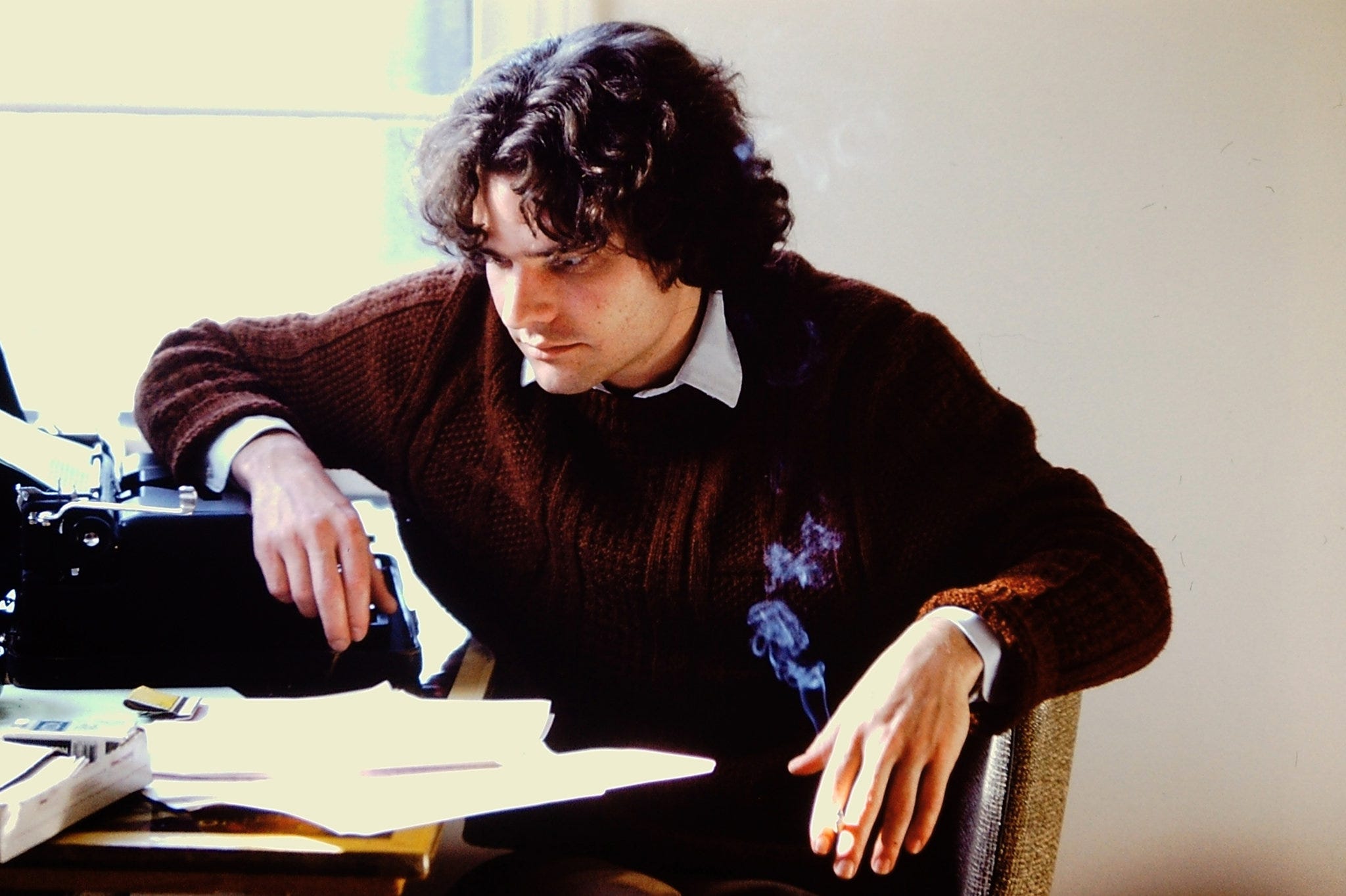
Life goes into new forms.
— Neal Cassady, the epigraph from Denis Johnson’s Resuscitation of a Hanged Man
Sometime in my mid-twenties I learned what it’d feel like to die if you knew it was coming. To hear your last heartbeats—Boom! Boom!—before the curtain fell. Before you slid finally into the warm, black bath. The very last one.
In May of 2017, Denis Johnson passed from liver cancer, a situation wrought by a dormant case of Hepatitis C—a case he’d contracted via shared heroin needles many decades before he’d ever learned of his illness. His work always, even at its most uneven, seemed to emerge from another place, a mode of writing that cannot possibly be taught. Because he had spent the 1970s addicted to heroin, alcohol, and much else, and ran around with criminals and was almost always destitute—emotionally and financially—Johnson had already prepared for the moments before death, doing so as he composed drafts of what would become his debut novel, Angels:
He was in the middle of taking the last breath of his life before he realized he was taking it. But it was all right. Boom! Unbelievable! And another coming? How many of those things do you mean to give away? He got right in the dark between heartbeats, and rested there. And then he saw that another one wasn’t going to come. That’s it. That’s the last. He looked at the dark. I would like to take this opportunity, he said, to pray for another human being.
A few days after I’d finished Angels for the second time, I was living in Gainesville, Florida. It was 2017, shortly after Johnson’s passing. In the midst of a shiftless, agonizing year I was looking for something that had the feel of restoration and renewal. Since I was going bald, a haircut would not do. I couldn’t afford a massage. So I drove to the Death or Glory Tattoo Parlour and had “He got right in the dark between heartbeats, and rested there” tattooed on my right tricep. (Talk about a performative male reader!) When you’re down and out, you don’t spend what money you do have on massages. You spend it on things that don’t do you any good. I am glad I got the tattoo.
I’m sure that night I’d gone from the tattoo parlor to the Palomino pool hall, or Main Street Bar & Billiards, or The Dugout with my buddy Billy to get drunk and do bumps of coke and chain-smoke American Spirits. Months later, after I moved from Gainesville to teach writing in Tennessee, and study on ways in which I could be a functioning human being, Billy went into treatment.
Billy had reserved a stretch of shelf for Johnson’s books, and when we’d lived together in a basement apartment a couple years before in Missoula, Montana, both studying creative writing, I scanned the spines of some stuff I hadn’t yet read: titles like Already Dead and Resuscitation of a Hanged Man, in spiritual and aural communion with what I’d already devoured: Angels. Train Dreams. Jesus’ Son. Titles that seemed to call from the fray between this world and another, howling out from a Shadow America I spent much of my early adulthood looking for: in the dregs of empty bottles, in pool halls, in Western small town dives, and in the bars and clubs where Billy and I played music. From Montana to Wyoming to Idaho to the Pacific Coast Highway, we traveled the landscapes and psychospheres Johnson had plumbed in Train Dreams and Already Dead. Places he’d lived in. The same America I’d listened for in The Basement Tapes and Love and Theft and Robert Johnson’s King of the Delta Blues Singers. In the Rockabilly Noir of David Lynch’s Wild at Heart, in Greil Marcus’s Old, Weird America.
You see now that I do not seek to demystify Denis Johnson, to demystify any of the abovementioned cultural ephemera of the Weird American Century—to demystify would be the aim of a responsible, clear-headed writer or reporter. I am not. I seek to mystify. I seek to mystify everything worth mystifying. Baby, that’s all we’ve got.
In our modern times, an age in which even the pleasure of gliding under a sparkling theater marquee and entering a singular dreamworld is threatened to become a pastime for the near-dead—in the name of God-Almighty-in-a-godless-world—may we please, please still have our myths, heroes, and legends? Without them, why would we try to create anything at all? People laughed when Timothée Chalamet said he wanted to be one of “the greats,” but I thought, good kid, good kid.
#
Like Bob Dylan, Denis Johnson’s genius emerged via experience, metamorphosis, and worship. Like Dylan, he did turn to Christianity at some point in his life but that’s not the kind of worship I’m talking about. He worshipped, for instance, Leonard Gardner’s 1969 boxing novel Fat City. He and his Iowa Workshop cohort passed it around in the early ’70s the way writers passed around Johnson’s short prose masterwork Jesus’ Son in the ’90s—and still do. Gardner’s novel dealt with down-and-out small-town dreamers afflicted by poverty, substances, and cruelty. But you also see in Denis’s pages, particularly in Angels, Gardner’s jewel-cut yet expressive prose, unflinching of its characters’ interiority, of emotion, of sorrow. A minimalism that pre-dated the clinically cool Carvers and Joy Williams’s of the 1980s (Carver’s final collection, Cathedral, released without the shackles of Gordon Lish’s red pen, did achieve Gardner’s and Johnson’s more vulnerable register). Johnson was also a lover of Beat literature and adopted their exuberance.
Much good writing carries the DNA, pretty clearly, of the author’s chosen ancestry. In a 1992 interview with The New York Times, Cormac McCarthy stated that “the ugly fact is books are made out of books. The novel depends on its life on the novels that have been written.” Johnson dove deep into the works that most affected him, lived inside them. He picked his grandparents, and then he went into new forms. He composed Jesus’ Son by taking copious hand-written notes of true life events that had happened to him in the late ’60s and ’70s, in Iowa City. You can teach methods of observation, of documenting experiences, but you cannot teach someone what to do with them. Johnson, with help of his chosen grandparents, figured it out.
“He was still alive, still dreaming obscenely.”
“If I opened up your head and ran a hot soldering iron around in your brain, I might turn you into someone like that.”
“It was there. It was. The long walk down the hall. The door opening. The beautiful stranger. The torn moon mended. Our fingers touching away the tears. It was there.”
“Darkly, darkly the Happy Hour.”
A less lyrical form of psychological realism can be beaten into the writer, much more readily than Johnson’s whacko-Americanzo-gonzo poetics. This explains the profusion of a more straightforward, pared-down domestic minimalist mode amongst college creative writing students, one that reigned supreme (reigns still?) for several decades since “dirty realism” first took hold in the 1980s. Johnson wrote a lot of short sentences, short paragraphs, short books. But Johnson’s minimalism is best understood when you consider his origins as a poet, his genre of study at Iowa. The poem’s aim of distillation to capture moments and images and arrest time, and the heightened rigor in its creation, informed Johnson upstream of his most successful pursuits in fiction writing. But then what cannot be taught, or traditionally learned, is the truer source of his creations: his own observations, his well-documented emotional instability, his sensitivity and rage, and his journeys into lurid corners of America most only read about in police-beat news or pulp novels.
In Ted Geltner’s 2025 biography of Denis, Flagrant, Self-destructive Gestures, the author discovers the extent to which personal experience and note-taking played a role in Denis’ process, but, to our relief, there’s not much in the book revealing how he honed his style, voice, whatever you’d like to call it. I’ll admit to searching for this amid the biography, but much of Johnson’s secrets are blessedly absent. I’d assume it is, like it is for many of us, a synthesis of key major influences, textured and reconfigured by the apprentice’s individual life. But I don’t really know.
But you can learn from the excerpt above, the one from Angels, in which we get right in the dark between heartbeats. It’s not the syntax or its exquisite rhythm, although there is that. There are broader lessons often not discussed in writing programs, online, or in literary scenes. One being that, in the direst of narrative circumstances, humor and hijinks can go a long way: “Boom! Unbelievable! And another coming? How many of those things do you mean to give away?” Exuberance. Well-placed exclamation points. A comic’s sense of timing. Johnson wrote like the probably-bipolar guy he was, following these ecstatic lines with poetic gravitas and ghastly weight: “He looked at the dark. I would like to take this opportunity, he said, to pray for another human being.”
All dialogue in the novel uses quotation marks, yet the “pray for another human being” bit doesn’t. We aren’t told that our man is saying these words aloud. Johnson cuts the quotation marks and asks the reader to sing along of this salvation.
Johnson could be fearlessly sentimental, reaching for a spiritual release in this scene’s final moments. A lesson one can learn from Johnson is to write with any and all registers of emotion available to a human being. Reject the stoic, anti-sentimentalist realism of much post-WWII fiction and over-workshopped prose. Johnson was a fan of the Beats and Delta Blues and Elvis and Dylan and he got arrested for protesting the Vietnam War and frequented movie theaters and neon-rich dive bars and taught poetry to murderers in an Arizona prison and spent time in a psych ward and moved from Munich to Japan and to Virginia and Iowa and Idaho and Mendocino County and married three times and sat at a Liberian prince’s compound watching videos of people being tortured—recounted in his nonfiction masterwork “The Civil War In Hell”—and once drove a new girlfriend he’d met in Alcoholics Anonymous and parked at an intersection and got out, held his hands out to stop traffic and hollered, “I love this woman! I love this woman!”
Denis Johnson was a whacko. Our literati seems increasingly bereft of whackos. This might not be a good thing.
I write of his whacky life because, again, I seek to mythologize him. He’s a nineteen year-old Elvis Presley at the Louisiana Hayride. He’s Dylan, his life going into new forms. He too rides the Mystery Train. Everything that is distinctive about America is peeled away by streamlined digital aesthetics and zombie-scrolling and restaurants with all the same furniture and soul-destroying lighting and hotel interiors like hospital waiting rooms and apartment complexes like office buildings—and what can you do? An artist today can only stay sane if they invite the more recently-dead into legend, surrendering themselves to and surrounding themselves by the technicolor ephemera of myth. This is all we get to hold into our chests until someone, somewhere, under the guidance of artists like Johnson, artists riding the old phantom train, finds our new Shadow America. Can put down words that pulse with its utter deranged madness. You’ll find it yet. Look around. It’s something worth aspiring to.
But not aspiring to art. Never art. Magic.
 | A guest post by
|
New Denis Johnson from Non Grata? I’m in
Incredible. Thank you for completely reviving Denis Johnson for me. (I’ve walked past that EMERGENCY sign at the Iowa City hospital so many times in my life!)