

Addressing Oprah and the Rest of Franzen's Haters (Pt. 2)
MXH is back to address the Franzen adversaries in turn


About Us: Non Grata is a print magazine and online publication aiming to revitalize literature. Our third print issue, Fiction from the Underground, is available now.
Barbarus hic ego sum, quia non intelligor illis.
(In this place I am a barbarian, because men do not understand me.)”
― Ovid
When I first started writing about Jonathan Franzen, I set out to rebut the haters who succeeded in defining him – no small task, given the volume and fleetingness of their charges and the residue that they left. I did good work, as you shall see, but I neglected to speak to what Franzen himself actually wrote.
Thus I broke the essay into two sides. On side A, published two weeks ago, I made the positive case for Franzen’s point of view and for his essays, which are as strong as anyone has written in our time:

This is side B. It focuses on the fourth strand of Franzenism: personal grievance, a tendency that recurs in most of his great essays. To discuss Franzen’s essays and thinking, the haters would have to be addressed. Since the haters have so colored Franzen’s work, you can hardly define Franzenism without addressing the haters, and to beat the haters you’ve got to beat all the haters. And this must be done to reclaim Franzenism.
Here we will discuss everything bad that has been said about Jonathan Franzen, and we will demolish the charlatans each in their turn.
Let us start with Oprah.
Oprah and the consequences
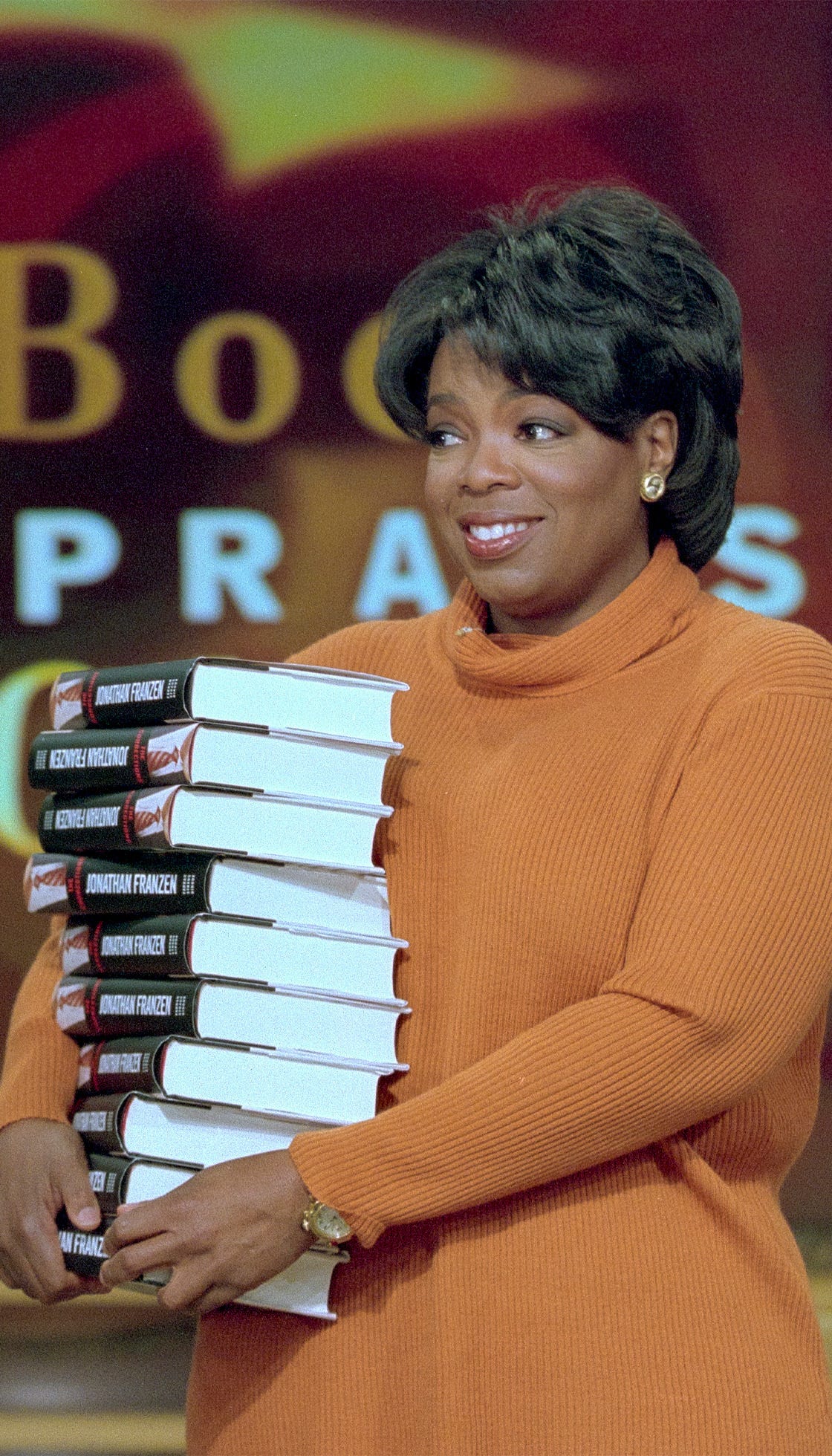
Jonathan Franzen first became a public figure in 2001, when he published The Corrections – and landed himself in a feud with Oprah Winfrey. Prior to The Corrections, Franzen was less notable as a novelist than as an essayist, best known for “Why Bother?” which he published in Harper’s in 1996. As discussed on side A, it was a pre-internet viral essay, a discourse igniter on a now-familiar theme: what is the place of the novel in a culture dominated by television?
Oprah Winfrey, meanwhile, was without doubt the most popular person on TV – and, by extension, in America. After launching Oprah’s Book Club in 1996, she became the biggest person in books, too, moving twenty to one hundred times as many books as the next biggest promoter. Consider her the original books influencer, operating at a pre-social-media scale that shall never be surpassed. No one has ever been, or will ever be, as powerful in print fiction as Oprah was in 2001.
Oprah’s endorsement lifted a book’s sales by 500k or more; so any normal, well-adjusted writer would have gladly done a bit of promo for Oprah and her cameras and cashed in the million-plus in bonus royalties.
But Jonathan Franzen is built different. When he got the call, he felt surprised and conflicted.
In “Why Bother?” he had described a muted TV broadcast as “an exposé of the hydraulics of insincere smiles,” whereas the “true novelist” was, in contrast, “an untelevisable personality.” Now, coerced by Oprah’s power to sell books, and the undeniable financial incentive this posed both him and his publishing team, he had to smile for the camera.
A film crew followed Franzen to St. Louis, though he would have preferred to be photographed in New York. (He saw himself as, and wanted to be seen as, a New York writer, which is so very Midwestern of him.) They took Franzen to his childhood home and insisted he emote for the cameras in front of the oak tree at which his parents’ ashes had been scattered. “This is so fundamentally bogus,” he then exclaimed, unbidden. An insincere smile Franzen might have borne, if only as a grimace. Performative grief, however, had brought him to his limit.
And when the Portland Oregonian asked if he really considered saying no to Oprah, he told them Jon’s honest truth:
Yes, I was very serious. I see this as my book, my creation, and I didn’t want that logo of corporate ownership on it.
Asked to clarify about the Oprah’s Book Club “sticker”:
It’s not a sticker, it’s part of the cover. They redo the whole cover. You can’t take it off. I know it says Oprah’s Book Club, but it’s an implied endorsement, both for me and for her.
The basic problem here is that Franzen does not want to endorse Oprah’s Book Club. The keen interviewer presses the point; our all-too-willing interviewee obliges:
The problem in this case is some of Oprah’s picks. She’s picked some good books, but she’s picked enough schmaltzy, one dimensional ones that I cringe, myself, even though I think she’s really smart and she’s really fighting the good fight.1
Aided by the interviewer, here Franzen articulates his real issue with Oprah’s Book Club. Yes, Oprah picked some great books, and got a legion of people to read Toni Morrison who might not have otherwise done so. But Franzen’s point stands. Many-to-most of Oprah’s picks were not complex, high literary books. David Gates said as much when he reviewed The Corrections for the New York Times, noting – a month before Oprah called Franzen to tell him the conflicting news – that the book had “just enough novel-of-paranoia touches so Oprah won’t assign it and ruin Franzen’s street cred.”
For all we know, Oprah had read this review and taken it personally. Franzen’s street cred be damned, she was beginning to worry about her own literary cred. She certainly took personally what Franzen said on NPR, a few days after his interview with the Oregonian:
It has been a source of pain that there are interesting male novelists out there who don’t find an audience because they don’t find a female audience. So much of reading is sustained in this country, I think, by the fact that women read while men are off golfing or watching football on TV or playing with their flight simulator . . . I’ve heard more than one reader in signing lines that said, “If I hadn’t heard you, I would have been put off by the fact that it is an Oprah pick. I figure those books are for women and I would never touch it.”
There was a tendency at the time to dismiss this line of thinking as sexist. But twenty-five years later, all anyone can talk about is why aren’t men reading books. The New York Times recently traced this, as Franzen does, to the celebrity book club culture that began with Oprah Winfrey:
Much of the architecture of book discovery is informally targeted at women. Celebrity book clubs are mostly led by female celebrities and increasingly court women of all ages, from those who are fans of Oprah Winfrey and Reese Witherspoon to those who are more interested in the tastes of Dua Lipa and Kaia Gerber.
Oprah, however, took offense. Her team reached out to his team, who told him if he couldn’t say anything nice about the biggest woman in bookselling, he shouldn’t say anything at all. He apologized both privately and publicly, though his public remarks sound like Greg from Succession:
To find myself being in the position of giving offense to someone who’s a hero—not a hero of mine per se, but a hero in general—I feel bad in a public-spirited way.
That was about all Oprah could take, and so she finally rescinded her invitation:
Jonathan Franzen will not be on The Oprah Winfrey Show because he is seemingly uncomfortable and conflicted about being chosen as an Oprah’s Book Club selection. It is never my intention to make anyone uncomfortable or cause anyone conflict. We have decided to skip the dinner and we’re moving on to the next book.
This is supremely catty. Read back through everything Franzen said about her, and you’ll see he’s always been sincere, never passive-aggressive. But then again, Oprah liked Franzen’s book, and she wanted to be friends. Franzen clearly didn’t like Oprah or her Book Club, and he especially didn’t like being asked to emote for the camera at his dead parents’ resting place. The whole affair left her pissed off and Franzen sick with anxiety.
As if on Oprah’s cue, the publishing industry turned on Franzen. Editors and agents publicly called him an “ungrateful bastard”, “a pompous prick,” a “whiny spoilt brat with a full diaper,” and, remarkably, “a guy from the country who shows up at court wearing the wrong shoes.” Even Harold Bloom chimed in.
Franzen remained apologetic, and insisted he had been misunderstood. But was anything he said wrong? Many of Oprah’s picks were sentimental middlebrow picks, and the Times had said as much, before she selected The Corrections.
The celebrity book machine grinds on. And men, believe it or not, continue to read books. Online, you’ll hear the vaunted “lit bros” rave about Cormac McCarthy, David Foster Wallace, Roberto Bolaño, various thorny Hungarians. But you don’t see them talk about many contemporaries, least not Americans. And why not?
As the Times noted, publishers pay far less attention to men, and this creates a self-perpetuating cycle: men can’t find appealing contemporary novels, so they don’t buy contemporary novels, so the industry stops publishing and promoting novels that might appeal to men.
On a larger scale, book promotion has overpowered the publishing industry and the critical apparatus that once determined what books would be published and promoted. And it began in 2001, when a TV influencer convinced the books business to turn on the most significant new novelist to come along in over a decade.
Right or wrong, it doesn’t matter. The fact is, Oprah won.2
Against the internet
Franzen would reconcile with Oprah in 2010, when she had him on her show to talk about his new book, Freedom. He also landed on the cover of TIME magazine, the first literary novelist featured there since Toni Morrison.3 Hailed as the next Great American Novelist, Franzen briefly became an unusual media darling – at the very moment he also became, for the first time, a Twitter Villain.
Yet it was not Franzen that began his beef with Twitter, but Jennifer Weiner, an airport novelist and Twitter mobster who got upset over Franzen’s Time cover and coined the confusing term #Franzenfreude:
Franzenfreude is taking pain in the multiple and copious reviews being showered on Jonathan Franzen. It’s about the establishment choosing one writer and writing about him again and again and again, while they are ignoring a lot of other worthy writers and, in the case of The New York Times, entire genres of books.
Weiner’s core gripe was that the literary media celebrated Franzen’s novels while neglecting to cover not only her books, but her entire genre of literature: “chick lit,” which is to say cheap romance novels. As cute as “#Franzenfreude” sounds, I can’t quite make out the connection here to the term “schadenfreude.” Given that she explicitly cites jealousy as her motive, perhaps a better term would have been Weiner Envy.
Franzen didn’t respond right away; he doesn’t Post, after all. Nevertheless, Weiner set the tone for all the internet conversations to come: Franzen was the out-of-touch old white guy, celebrated by the sexist literary media. As Michelle Dean put it, writing for The Awl:
Really, we’re still doing the thing where we elevate a fiction-writing white men as the Greatest Thing In American Writing Today? And not blushing a little when we do this?
Although this opinion was based on Weiner’s attacks rather than on anything Franzen ever wrote, it has held up over time as the Vox-and-friends consensus. Here’s how they described him a decade later:
Franzen, the man with his name in the hashtag, came to seem like a symbol of the problem: a white man with all the literary credibility in the world, a white man who had literally been declared the great American novelist while so many other great writers labored in comparative obscurity . . . It was becoming gradually clearer that the binary so many people used when they talked about Franzen, the binary between fun books and serious books, was a gendered one. Franzen was perceived as part of the system that made it that way — and he was a snob to boot.
Was the literary establishment of 2010 biased in favor of men? I think so. If you count up who got reviewed – as people did after the whole #Franzenfreude thing – you would find that papers such as the Times covered books by men more often than books by women. Franzen acknowledged this repeatedly, and made a point to promote women writers, such as Alice Munro and Rachel Kushner, well before he was ever called out for being a white man.
Franzen wouldn’t substantially respond to Weiner and her Twitter mob until 2013, when he published The Kraus Project, his heavily annotated translations of Austrian satirist Karl Kraus. The Kraus Project is at the heart of Franzenism, so I discuss it in depth on side A. As pertains to Weiner, I will only note here that he throws her in with the “yakkers and tweeters and braggers” that prosper in the brave new social media world, while “literary novelists are conscripted into Jennifer-Weinerish self-promotion” under this new regime.
Weiner rushed to play the victim – never mind that she started it, cheerleading the #Franzenfreude mob against him in 2010. Personally I think it’s weak as hell to start a fight and then act like you’ve been attacked, but Jezebel et al. were happy to play along.
Two years later, Franzen called Weiner, with her self-serving attacks, “an unfortunate person to have as a spokesperson” on “an important issue”:
To me it seems she’s freeloading on the legitimate problem of gender bias in the canon and in the major review organs to promote herself, basically. And that seems like a dubious project that is ideally suited to social media, where you don’t actually have to argue, you just tweet.
In response, Weiner retconned the whole #Franzenfreude thing into two more nuanced takes: On the one hand, papers such as the Times were unfairly covering male genre writers while ignoring women genre writers, such as Weiner herself. And at the same time, they were also favoring men in their literary coverage.
But the connection between these two issues is tenuous: ultimately, Weiner is promoting her own works by dragging Franzen’s name, characterizing him publicly as a white male literary snob. If her real issue was genre coverage in the New York Times, why was she cheerleading identity-based attacks on Franzen?
And if Weiner’s self-promoting attacks made her an “unfortunate spokesperson” on this issue, I would also suggest Franzen is not such a great target, either. Bitch about the New York Times not reviewing women all you want, but when Franzen reviewed Alice Munro’s Runaway for the Times in 2004, he made the hard case for giving her the Nobel Prize, calling out the Swedish Royal Academy directly: “Enough is enough!”
But this wasn’t enough for Twitter and company. When Franzen mentioned in one interview that he’d often championed women writers – a direct response to everyone trying to pin literary male bias on him in particular – Mary Elizabeth Williams at Slate responded with, well, this:
Awwww, poor victimized famous bestselling author Jonathan Franzen! Why are feminists so meaaaaaan?
Here’s some advice. A good way to prove that you are not a sexist is not to whine, LOOK HOW MUCH I DO FOR YOU WOMEN AND YOU DON’T EVEN APPRECIATE IT. It’s understanding that being part of the problem of the incessant sexism that we women deal with every goddamn day of our lives — in our jobs, in our quest to maintain our right to reproductive autonomy, in our desire to just walk down the street in peace — isn’t just “going around” saying out loud that men are superior. So, you know, sorry if we don’t seem sufficiently grateful, dudes.
Franzen can’t change who he is, but for most of his career he’s made a point to praise and promote women writers. Given his own status in the literary world, that’s about the best thing he could do, especially if the problem is male bias in the literary media. If the problem is – I’m reading Williams’ problem as all sexism ever – what exactly do you want Jonathan Franzen to do about it? She alights on his calling Weiner “an unfortunate spokesman,” describing it as “a smug dismissal of female authors,” as though Franzen owes it to celebrate every woman writer ever, including an airport novelist who repeatedly dissed him, unprovoked.
For Slate’s part, not two weeks later they ran another piece taking the opposite angle:
It’s worth remembering, too, that he was a major force in digging Paula Fox’s distilled and sharp-eyed work out of obscurity . . . Franzen, for what it’s worth, has been a longtime booster of short-story master Alice Munro, and he became a teacher and booster of “Flamethrowers” novelist Rachel Kushner.
… though it refuses to commit to an argument stronger than “Franzen deserves to be treated as more than just a punchline.”
Franzen provoked another Twitter pileup when he published “A Rooting Interest”, his piece on Edith Wharton, in the New Yorker. In it, he describes her as an unsympathetic character: she was intense and difficult, born rich, and would write in bed, tossing her finished pages on the floor to be typed up by her assistant.
The Wharton piece called forth a fresh legion of attackers, many of whom picked over so-called inaccuracies. Roxana Robinson, for instance, writing at the Center for Fiction, claims that “Though Wharton was born into a privileged circle, she didn’t lead a life of undiluted privilege. Her family was financially on the outer rim, and they suffered economic setbacks.” I don’t know what she could possibly mean by the financial “outer rim” here. Wharton’s family lived in a midtown Manhattan brownstone and summered in Newport. Maybe they were on the outer rim financially relative to the Rensselaers and the Astors, to whom they were related? They weren’t poor, in any case. In 1893, Wharton and her husband bought a house in Newport for $80,000, nearly $3 million in today’s dollars. Not ten years later, they moved into the Massachusetts country mansion Wharton designed herself. If that’s the financial outer rim, send me to it.
Throughout the piece, Robinson fixates on Franzen’s seeming lack of sympathy for Wharton and her characters, writing entirely at cross purposes with what Franzen actually wrote. That Wharton and her characters are unsympathetic is his starting point; his central concern is how Wharton makes us sympathize with them anyway, and by extension why Franzen finds Wharton herself a sympathetic character after all, even though she is not the easiest person in the world to sympathize with.
So to say Franzen has an “inability to feel sympathy for these characters” willfully misses the point. When Franzen calls Wharton an “isolate and misfit”, he doesn’t mean it as an insult; for him, these are terms of endearment.4 Throughout the essay, Franzen admires and examines Wharton’s techniques for earning our sympathy. It’s fundamentally an essay on the craft. But these web writers are unable to consider his essay except in plainly moral terms: Franzen said something unflattering about Wharton, so this must mean he hates her, but he is mean and wrong.
One particular point of Franzen’s aroused a special fury. He identified “one potentially redeeming disadvantage” on Wharton’s part: “she wasn’t pretty,” which he leverages to make a key point:
An odd thing about beauty, however, is that its absence tends not to arouse our sympathy as much as other forms of privation do. To the contrary, Edith Wharton might well be more congenial to us now if, alongside her other advantages, she’d looked like Grace Kelly or Jacqueline Kennedy; and nobody was more conscious of this capacity of beauty to override our resentment of privilege than Wharton herself. At the center of each of her three finest novels is a female character of exceptional beauty, chosen deliberately to complicate the problem of sympathy.
To the haters, though, “Wharton’s appearance has no relevance to her work,” and Franzen here is simply “perpetuat[ing] the typically patriarchal standard of ranking a woman’s beauty before discussing her merits, whether she is an intellectual, artist, politician, activist, or musician.”5
A more charitable reading of Franzen here might see this line from a point of identification – which is to say, Franzen’s maybe not so pretty himself.6 Of course, “not pretty” carries a very different weight when applied to a woman. Unlike men, girls don’t get to be ugly hot, as Chrissy notes on Transtender. She might as well be describing our man: “He can’t rizz the hoes, but he can identify the American Goldfinch by its bright yellow body and conical bill.”
In the end, there’s hardly a cancellable offense we can pin on Franzen in all these Twitter wars. Yet the attacks on Franzen not only stuck, they piled up. Why?
There are two fundamental reasons. One is Franzen’s willingness to air disputable opinions. Millennial internet culture, especially on Twitter and the websites orbiting it, built for consensus. You supported net neutrality and the latest certified fresh Marvel movie, and you opposed Seaworld and Joseph Kony. Whenever something new happened, the Twitter consensus asserted itself in a discrete value judgement, and the attending websites all chimed in with their regurgitated opinion on the current thing. These websites would not air a take contrary to this consensus, and if someone made a disputable point – such as Franzen’s case against Twitter and Facebook – the Twitter consensus was Go fuck yourself.
Whether or not you identified with this array of easy homogenous takes at the time, they are in hindsight terrifically boring and unmemorable pieces of writing. If you are not willing to share a disputable opinion, you have no business writing essays in my opinion, which you are welcome to dispute. Any serious essayist should, when the occasion calls for it, put their balls on the proverbial table, as Ta-Nehisi Coates did when he released a book calling Israel a racist apartheid state soon after the October 7 attacks. But serious essayists were scant in the 2010s, because the internet media environment was so viciously hostile to any writer who stepped out of line.7
And this internet media was especially hostile to people who looked like Franzen. Far and away, this was the most consistent theme in the attacks on Franzen: that he was a straight white man. These identitarian remarks were permissible amidst a media culture that encouraged them, and the attacks themselves furthered this culture, giving cover for anyone else to make similar attacks and to otherwise discriminate on grounds of gender.
The war on Franzen was a key early chapter in the culture wars of the 2010s. Well before cancel culture hit its stride, he was effectively shouted out of the public sphere, and over what? I propose we take his fiercest critics as their word: Franzen’s inescapable original sin was being a white guy on top of print literature when the rising internet media turned against white guys, starting with him.
Against the world
On side A, I identify a few recurring strands that run through Franzen’s essays. When he writes a piece, he doesn’t know where he’ll end up – he has to figure out his way there through the writing. He is broadly opposed to capitalism, with its combination of corporate power, consumerist exploitation, and enforced optimism about technological progress. Instead, Franzen asserts an anti-modern viewpoint, defining writing as an act of preservation, most of all preservation of the literary community.
We must also admit there is a strand of personal grievance that runs through many of Franzen’s best works. In “Why Bother?”, the pervasive media machine seems oddly directed at him, designed by Moloch to crush this young midlist novelist in particular. In his account of the Oprah imbroglio, Franzen suggests that if Oprah and her team had not coerced his participation in an inauthentic media circus to the point of being made to perform grief for the cameras at his parents’ resting place, he might not have objected to her corporate logo on his book as repeatingly as he did. His attacks on the internet, including those in The Kraus Project, seem motivated in part by a frustration with people such as Jennifer Weiner ringleading Twitter mobs against him, for the sake of gaining followers and selling their own books. In that light, The Kraus Project might be seen as Franzen laundering his righteous anger through his more wholesome devotion to Karl Kraus.
And this tendency is especially pronounced in his beef with the Audubon Society. He began writing “Save What You Love” around 2015, but he set it aside: “For the writer, an essay is a mirror, and I didn’t like what I was seeing in this one.” By his account, only after he discovered the Audubon Society was using his likeness without permission to promote their fundraising efforts did he finish the piece and publish it in the New Yorker.
His principal issue: conservation groups have been putting climate change ahead of more pertinent concerns. He cites a particular report the Audubon Society was using to support its fundraising, which claimed climate change was the #1 threat to bird populations; in Franzen’s view, there are far more pressing concerns at hand, namely habitat loss.
The Audubon Society, in turn, accused Franzen of “extreme intellectual dishonesty,” in a piece penned by Mark Jannot, their VP of Content. Jannot focuses on a particular example Franzen had used, insisting that Franzen deceived readers in his characterization of local bird blogger Jim Williams, who, in Franzen’s account, had said the deaths of a few thousand birds by stadium glass would be “nothing” compared to climate change.
Here’s the quote Franzen originally took issue with, as printed in the Minnesota Star-Tribune:
“We’ve been talking about birds being killed by flying into glass,” Jim Williams, a bird expert who writes the Wingnut blog for the Star Tribune, said in referring to a recent controversy over the design of the new Minnesota Vikings stadium. “That’s going to be nothing compared to this.”
And here’s Franzen’s characterization of it:
Audubon’s announcement was credulously retransmitted by national and local media, including the Minneapolis Star Tribune, whose blogger on bird-related subjects, Jim Williams, drew the inevitable inference: Why argue about stadium glass when the real threat to birds was climate change? In comparison, Williams said, a few thousand bird deaths would be “nothing.”’
Am I fucking tripping, Dear Reader? Because I don’t see the least distinction between Franzen’s characterization and what the Star-Tribune printed. In both cases, Jim Williams said that next to the consequences of climate change, the birds killed by stadium glass were “nothing” in comparison.
If I’m belaboring this point, it is only because the Audubon Society insists that “Franzen’s entire argument . . . rests on the wafer-thin foundation of Mr. Williams’s quote.” Williams calls Franzen’s supposed mischaracterization “an intellectual sleight of hand” and insists that “Jim Williams didn’t actually dismiss the deaths of thousands of birds as ‘nothing.’ Not even close.”
This accusation of dishonesty is their entire counterargument against Franzen, their case that what he wrote about – conservation groups putting climate change ahead of conservation, for the sake of fundraising – simply wasn’t happening. Even though they were, for all appearances, a big conservation group putting climate change ahead of conservation the sake of fundraising. They had, after all, just put out a report claiming climate change was the #1 threat to birds. Franzen claimed, to the contrary, that habitat loss and outdoor cats were more serious threats to bird populations.8 To actually prove Franzen wrong, they would have had to argue this point, make the hard case that climate change was, in fact, the #1 threat.
But they did not dispute this point. Instead, they called Franzen names, said what he had pointed out wasn’t happening (even though they very much seemed to be doing it), and tried to wash their hands of the matter as best they could.9
Franzen brought out the haters again with his next piece, “What If We Stopped Pretending,” which argued that serious climate change impacts were inevitable and so we should act accordingly.
Here we can see the anti-Franzen line evolving. For one, there’s a new emphasis on Franzen as specifically a white man, reflecting the shift in emphasis that took place in the mid 2010s – as one tweeter noted, “these bad takes . . . invariably come from privileged, western, white men”. There’s also the “argument” that Franzen isn’t a climate “expert,” so why would the New Yorker even publish him? These elements combine to make a neat little point: the New Yorker only published Franzen because he’s a white guy.
The only problem is that the New Yorker had two perfectly legitimate reasons to publish Franzen on this issue: Franzen is one of the most acclaimed and best writers of our time, and this is a damn fine piece. To cast these reasons aside devalues the craft of writing, degrades our literary culture, and makes our time a lesser one, at least if you care about reading and writing.
One might have expected our literary institutions to push back against this tendency which devalues writing itself. You might expect other writers to come to Franzen’s defense, whether against Oprah or Weiner or the Audubon Society or, most crucially, against the Twitter mob in general.
But our writers are a bunch of goddamned cowards, and they were afraid of the mob, so they left Franzen to it. The craven institutions, New Yorker included, folded to the new consensus; though the mob has somewhat dissipated since, the credentialed grifters midst the gang have now occupied these institutions. But this is old news. As Dwight MacDonald wrote in 1958, “One can guard against the Philistines outside the gates. It is when they get into the Ivory Tower that they are dangerous.”
It ain’t over yet. Now that Twitter has been sacked by actual Visigoths, we can rebuild the culture a little more locally, rather than on the mob rule megalopolis panopticon that was twitter.com. New houses are going up every day. We are rebuilding the literary community a brick at a time, and sure enough we will soon begin in earnest rebuilding the audience for real literature.
It will take years. Probably it will take a generation. Maybe it takes a lifetime. I will do what I can to rebuild in Franzen’s time, and in mine. If there’s something left when we’re done, great.
But I am building this for you, Dear Reader. Let us build it for the present.
Consider this a case example in how interview quotes get recirculated out of context. “Franzen calls Oprah’s Book Club ‘schmaltzy’” becomes the headline and “The problem is Oprah’s picks” goes in the lede, as though Franzen held a press conference to announce these opinions – when in reality the interviewer had to coax them out of him.
Franzen won, too, in a sense: even more than the book itself, the Oprah imbroglio made him as close to a household name as a literary novelist can get in the 21st century. But his victory made him vulnerable; to most people, Franzen would always be the snobby novelist who called Oprah’s Book Club “schmaltzy.”
Stephen King had appeared on a very strange cover in 2000, on a story focused not on his works but on the creative potential of the internet. Maybe they should have picked George RR Martin, whose blog posts tracking the New York Giants would later be flooded with desperate fans begging him to finish Winds of Winter.
As described on side A, the turning point of “Why Bother?” is a moment of profound recognition when anthropologist Shirley Brice Heath looks Franzen in the eye and reads him for who he is: “You are a socially isolated individual who desperately wants to communicate with a substantive imaginary world.”
Some of this early 2010s internet writing is spectacularly deranged. Here’s one summary of Franzen’s Wharton essay, as described on one blog: “The basic gist of Jonathan Franzen’s New Yorker article on Edith Wharton is, ‘Whar-dawg, I do not dig you as a human being because you had too much cash flow and too few socially liberal political beliefs, but I do dig the hot fudge sundae that is your novels’ complex protagonists. Radical?’ (Franzen talks like a surfer-dude undergrad from the 1960s with hip-hop influences. No, he doesn’t really. I wish.)”
If I’m more reluctant to weigh in on Franzen’s attractiveness than he was with regard to Wharton’s, it is only because I am so handsome.
Notably, Ta-Nehisi Coates came up through The Atlantic when it was still a print-first publication. And though his point about Palestine would not have been so controversial on Twitter, he wasn’t making the case on Twitter, he was out here on CBS.
Okay, I gotta admit that the anti-cat position, legit or not, is a hopeless fucking endeavor. Amidst the 2010s internet, coming out against cats was the most comically contrarian take you could possibly conceive.
Jannot also accused Franzen of bias, since he “sits on the fund-raising board of directors for the American Bird Conservancy, an organization that fancies itself a competitor for funding and attention with Audubon.”
But this puts the chicken before the egg: while it is perfectly plausible that Franzen chose to impugn the Audubon Society because of his association with the American Bird Conservancy, it is just as likely that he became involved in a rival group because he had become disillusioned with the Audubon Society.
Probably both are true, and so what if they are? Franzen would be guilty of what here, advancing the interests of the American Bird Conservancy in the face of a much bigger and better-known group? Lock him up already.
 | A guest post by
|