

Pulverizing the Prize-Seeking Careerist Writer
A short story from Naomi Kanaki


About Us: Non Grata is a print magazine aiming to revitalize literature. The following piece is from our Summer issue, “Fiction from the Underground,” available for purchase now.
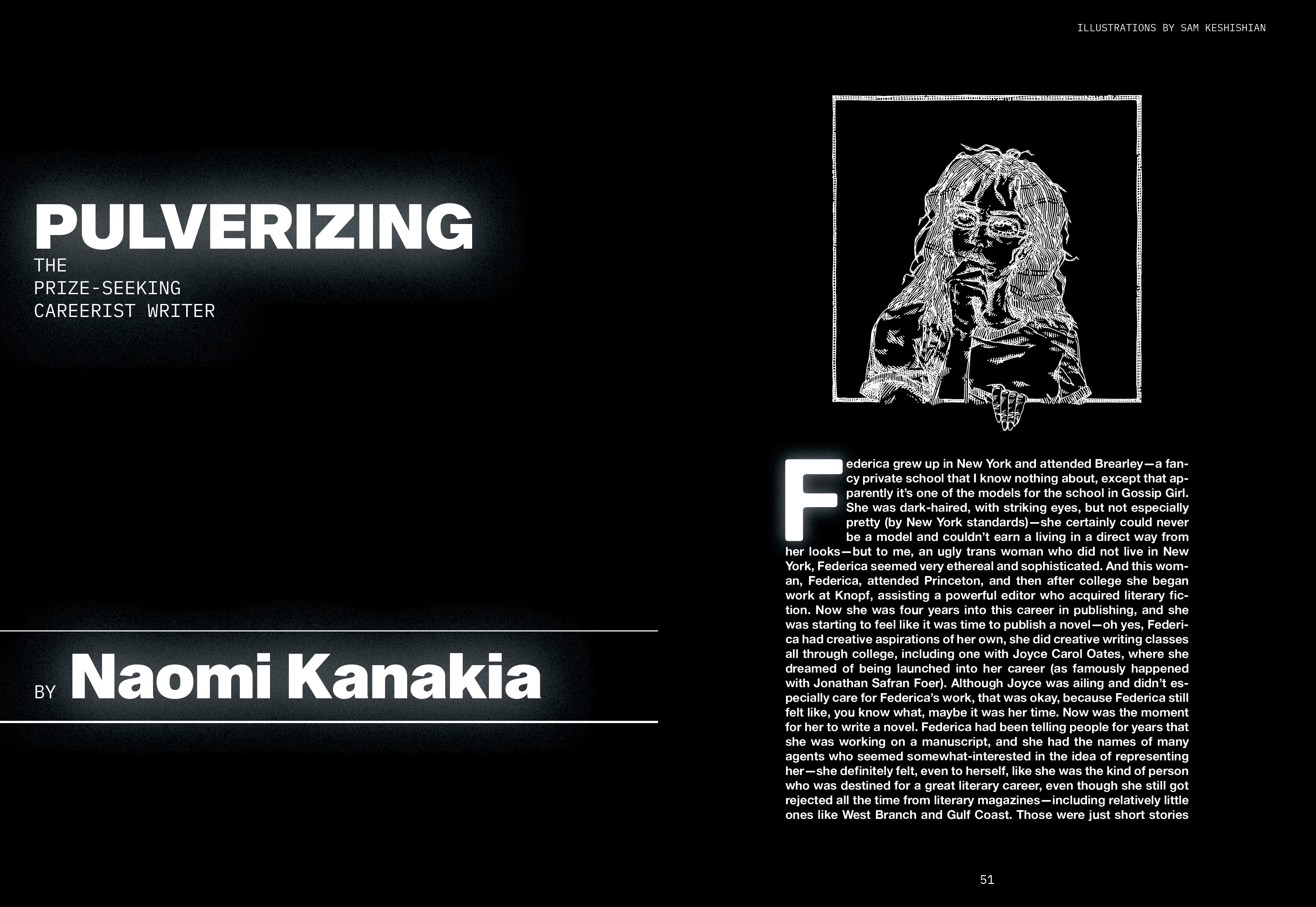
Federica grew up in New York and attended Brearley—a fancy private school that I know nothing about, except that apparently it’s one of the models for the school in Gossip Girl. She was dark-haired, with striking eyes, but not especially pretty (by New York standards)—she certainly could never be a model and couldn’t earn a living in a direct way from her looks—but to me, an ugly trans woman who did not live in New York, Federica seemed very ethereal and sophisticated. And this woman, Federica, attended Princeton, and then after college she began work at Knopf, assisting a powerful editor who acquired literary fiction. Now she was four years into this career in publishing, and she was starting to feel like it was time to publish a novel—oh yes, Federica had creative aspirations of her own, she did creative writing classes all through college, including one with Joyce Carol Oates, where she dreamed of being launched into her career (as famously happened with Jonathan Safran Foer). Although Joyce was ailing and didn’t especially care for Federica’s work, that was okay, because Federica still felt like, you know what, maybe it was her time. Now was the moment for her to write a novel. Federica had been telling people for years that she was working on a manuscript, and she had the names of many agents who seemed somewhat-interested in the idea of representing her—she definitely felt, even to herself, like she was the kind of person who was destined for a great literary career, even though she still got rejected all the time from literary magazines—including relatively little ones like West Branch and Gulf Coast. Those were just short stories though—maybe her novel would fare better. But maybe not! Federica had definitely considered the idea that maybe she was no good. Maybe she had no talent. Maybe she was all image. Maybe she sucked! And, meanwhile she was really envious of this other girl Dominique, who also grew up in New York—who was a high school classmate of Federica—but who didn’t need to work because Dominique’s father was a very successful transplant surgeon who really believed in her. He paid her rent and somehow money was never a concern for her. Whereas with Federica, it was different—Federica’s dad was a former TV showrunner who kept suggesting she go to law school, saying you know honey, your time actually does run out, and then it’s hard to switch careers—you have a lot of promise, and you’d be such a successful lawyer, and…Federica just felt as if she was lagging behind, felt like a disappointment to her family. Her dad made his bones in a creative field, but somehow he felt like Federica didn’t have the magic touch. And meanwhile Dominique did have the magic touch. Dominique had founded a magazine, and each quarter its pages were filled with up-and-coming writers who were selected by Dominique personally. God knew where she found these writers, but they felt very off-beat, very askew—they were always tattoo artists and ex-cons and people like that, rather than the usual literary striver types. And these writers were so grateful for Dominique’s attention that she somehow bypassed the defenses they’d normally have against this kind of born-rich girl, because in truth Dominique had an animal cunning that allowed her to see what was cool, what was getting traction, and to arrive there just a few minutes before everyone else did—which was a legitimate skill, honestly, and one that Federica envied, because she had nothing like it. Instead, Federica had spent ten years reading books, not bothering with literary scenesterism, just studying the great writers of the past. But where had that gotten her? Now she’d been pumped full of these thoughts about genius, and it was like, okay Federica, now it’s your turn to produce your own genius first book! So where is it, huh? Lately she’d been playing around with a book that was written in one very long paragraph—a clear homage to the work of Austrian writer Thomas Bernhard. He was a comfort read for her, honestly, because his most famous novels were about artistic types who feared being mediocre, and about the smallness and pettiness of that fear. Bernard was most well-known for The Woodcutters, a book in which he viciously sent up the friends from his youth, who were all now (in their fifties) successful artists. He called them talentless hacks who were being supported, essentially, by the government. This book aroused a huge stir in Austria when it came out, and it resulted in him being sued by one of his old friends, which just showed that Bernhard was right—those guys he was criticizing, they actually were mediocrities. They were institutional artists, dependent on the largesse of the system, without a vision of their own. And these institutional artists still existed even today! Federica had perceived that her own employer, Knopf, had also published a number of institutional artists—women and men whose entire life was the performance of genius. Their work was nothing more than a collection of tics and devices. It was designed not to serve any higher aim and certainly not to serve the reader, but merely to provide an occasion for reviewers to claim that the writer was a genius. There was a writer named Kevin Lowell, a writer for Knopf, whose work Federica absolutely detested. This writer was quite smarmy and self-important on a personal level, and he was a lover of Thomas Bernhard. He wrote one-paragraph books that dwelled interminably on the crystalline details of a scene. This writer, Lowell, subjected you with endless, sweating, groaning tedium to his own consciousness, but what you learned in reading his work was this consciousness didn’t contain a single ugly or untoward thought. This writer had never wondered whether some races might be stupider than other races, for instance. He never thought, even as a stray thought, about molesting children. He never even texted while driving, and then thought, while texting and driving—wow I could probably kill someone right now, and my life would change completely if that happened. What I am doing is wrong, but I somehow can’t stop! Instead, this writer wrote these long, one-paragraph books that were commonly called “works of genius”—and indeed he was the recipient of a MacArthur genius grant. He was a professor at Michigan and wrote essays that often appeared in The New Yorker and The New York Review of Books, and everything about this writer was carefully-designed to avoid any form of criticism. He never ever said anything that might not be in good taste. Something that could get screenshotted and mocked online. This writer was just an empty vessel—he was a placeholder—by honoring this writer, we honor the “idea” of genius. Which was a great thing to do! But when you honored such talentless people, maybe you actually devalued genius instead. If Lowell was a prize-winner then it meant winning prizes was actually bad—a prize was actually a mark of dishonor, just like Bernhard had said (he’d written something like, “If you accept a prize from someone then you are allowing them to piss on you”). Anyway, Federica was pretty sure that this writer, Lowell, wrote primarily to receive prizes. He didn’t care about the readers, didn’t care about advancing literature. He just wrote in order to receive prizes and to be praised by critics. And there were many such writers out there who didn’t care, necessarily, about engaging with readers. They just wanted to produce books that would be reviewed well and that would win prizes. They wanted to travel the cursus honorum and eventually ascend to their position as a genius. And Federica understood this literary-striver psychology, because she was exactly the same. She wasn’t a cool girl—far from it. She was desperate and insecure, and she had been on Twitter from the age of fifteen—lurking for many years—trying to figure out which were the right books to read, and often feeling bad because when she read these books she didn’t experience anything. She had tried to read Proust many times but always found him boring. Same thing with Ulysses, which was not just boring but also incomprehensible. She wanted very badly to experience what other people claimed to experience from these books, but somehow the experience had never come. She wished many times that when she was fifteen she’d gotten into fan fiction instead. Nowadays the rage in the publishing industry was for these fan-fiction authors, right? These authors wrote their Draco/Hermione fanfic and posted it anonymously to AO3, and it just hit people’s buttons so thoroughly that these authors became famous, under their pseudonyms, as fanfic authors, and then eventually got publishing deals. Federica envied them. Sometimes she went on AO3 to try and figure it out, but the interface was somewhat forbidding. She had also tried to read a few of these popular fan fictions, which always seemed to be about Draco Malfoy keeping Hermione as a sex slave—a scenario that Federica found to be very hot. But when she read these stories she somehow couldn’t fully relax into them, because she was so aware of herself as not being the kind of person who read fan fiction. But, still, she would love for her writing to be as free and unrestrained as these fan-fiction authors—these women who were writing purely for love, who weren’t motivated by careerism. Was it possible to write a novel for Knopf and still have that passion for the work? Obviously everyone who published with these literary presses claimed that this work was their life, and they were so inspired or whatever, but she didn’t believe that this was actually true. She thought most of the people publishing literary fiction from big presses were sad, desperate and afraid, they were fakes, just like her, who wrote defensively, and all they cared about was not being exposed as frauds. Federica hated both herself and these other writers so much that she couldn’t help chewing endlessly on these vile, negative emotions, until they finally came pouring out of her in the form of an epic plotless rant that superficially resembled a novel.
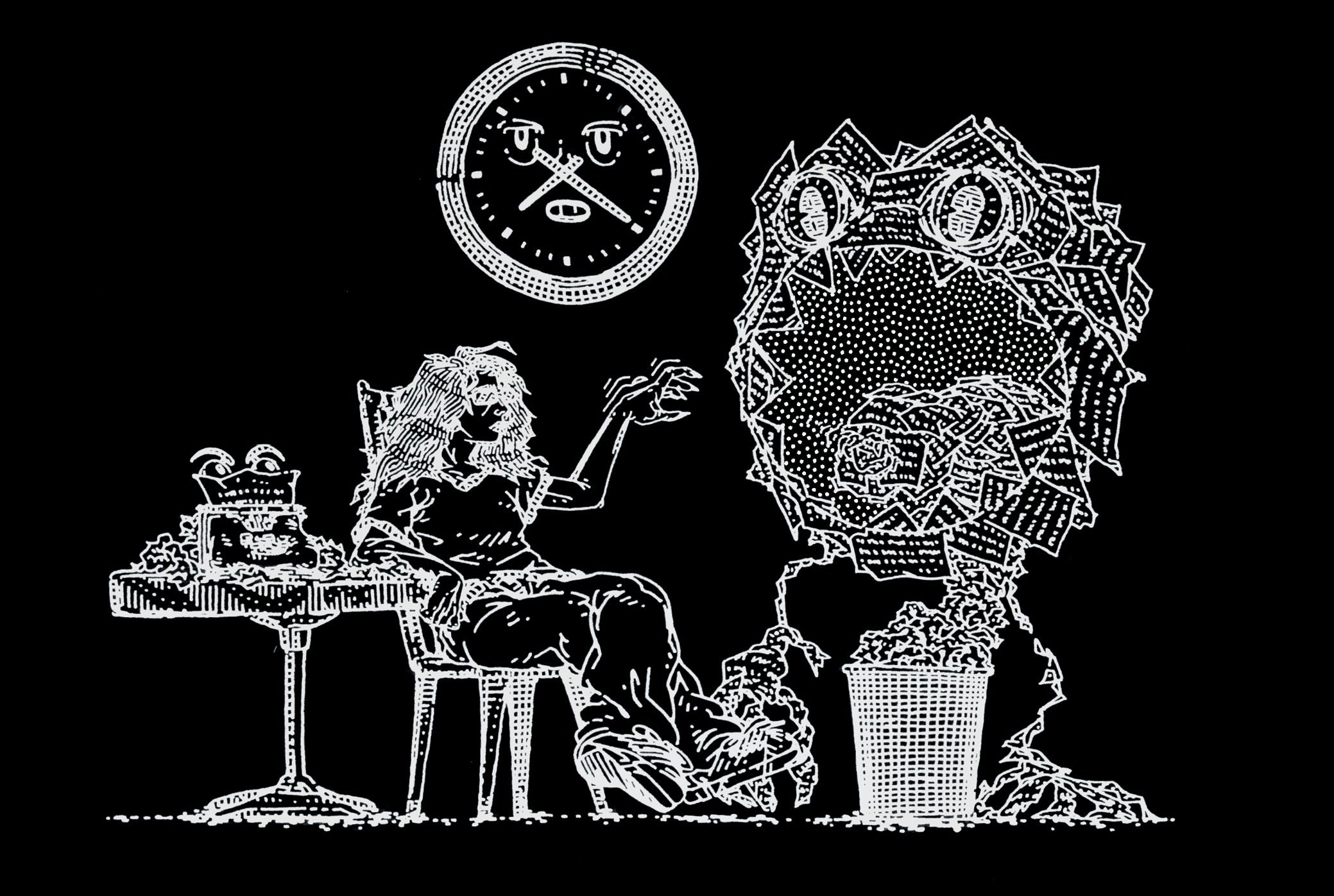
Federica’s debut novel, The Careerist, was written about a prize-seeking careerist writer. In this book, she enjoyed lashing out, creating portraits of all the various fakes she knew, including Lowell and Dominique. Then she put herself into the novel as just another faker—just another mediocrity—who was distinguished from the rest because she was more self-aware. And then she wrote up a list of ten agents she’d met over the years. She started sending out emails, and she got reads right away—the first offer of representation came within forty-eight hours. This book, The Careerist, eventually sold for $275,000, in a deal that signaled the faith, by her publisher, that they were launching a major talent. Which was great, except for one thing: in the months after that deal, she had a lot of writer’s block. She felt written-out. In her debut she had basically attacked the entire concept of writing novels for a cultivated audience. So what was left for her? And then, worse news, the book’s release fell kinda flat. Federica had that feeling that I, Naomi, know really well, where about two months before a book’s release, suddenly your editorial team was a lot less excited, because they’d realized somehow, through some weird telepathy, that the book wasn’t really going to happen, whatever that meant. Like, obviously nobody thought the book was going to win a Pulitzer, but everyone hoped it would launch her as a major talent, someone to watch, somebody like Dominique or like Kevin Lowell himself. And…it didn’t sound like that was going to happen. Which is fine, but where did it leave her? That was her book. That was her chance. She did her best. And now she had no idea where she’d gone wrong in life. Like…she couldn’t even remember why she wanted to write books in the first place. She had no sense of who read these novels, or why those people read them in the first place. She herself didn’t read any contemporary novels, because they were just a nexus of loathing and shame for her. Like…back before her novel had failed, she had a year-long period where she read contemporary novels with interest, thinking maybe these people will be my peers. Now it just felt very different—the bookstore was a harsh, forbidding place. And many of her writer friends were privately confessing that they didn’t like contemporary fiction much themselves. So okay…then what did they like? People said the novel was dead—she read so many reviews that said the novel was passé, there was nothing exciting you could do anymore with it. But that was just clearly not true—obviously there was one exciting thing you could do, which was make Draco Malfoy keep Hermione Granger as a sex slave—something that clearly excited a lot of people (including Federica herself) very much. Obviously there was some kind of raw energy in the fanfic-reading population—the population of people who read Hermione sex slave books—that Federica’s own people, the aesthetes, really lacked. These aesthetes were enervated and joyless, so they pretended like somehow the novel itself wasn’t exciting anymore, but really what had been lost was their passion for this empty, careerist, institutional literature that they somehow feel honor-bound to extol. Honestly, Federica would’ve loved to connect with some community of people who actually enjoyed reading and who felt excited by books, but she wasn’t sure where to find those people, and she understood that she herself was the problem, because she had exuded so much judgement over the years—judgement that she believed sincerely, at the time, but which she realized now was just insecurity. Like the nice thing about Dominique was that, sincere or not, she was willing to praise people. Yes, maybe Dominique was only reading peoples’ work because those people had buzz, but…maybe she was just genuinely interested in trying to understand whatever other people were excited about! Was that such an impossible thing to believe? Dominique was basically a cool-spotter. She had some kind of underground taste. She understood what was up-and-coming, but on a level much prior to the publishing companies or mainstream critics. And Federica had always thought this was mercenary, because Dominique just wanted to be associated with whatever was trending. But, you know, during the period when Federica had thought her own book might succeed, Federica had noticed a fawning quality in herself, where she would feel compelled to praise other contemporary writers who also had books coming out. So she’d write about them or write to them, and their response would seem a bit perfunctory, like they could sense that Federica was being insincere. In contrast, Dominique didn’t have to worry about that, because she often noticed writers when they were really underground and weren’t yet bored of flattery. She encouraged people who hadn’t necessarily gotten a lot of mainstream encouragement yet—these writers were only hot because Dominique had noticed them, or at least that’s how it often seemed, which meant that actually Dominique was something of a taste-maker, not just a trend-follower. Anyway in her novel, The Careerist, Federica had complained about this tendency for writers to glom onto trends and feed psychically from whatever seemed hot. But maybe that was actually a good thing to do! Maybe it was actually good to want to be influenced by other people. Like, Federica herself had been thinking for so long about these Hermione sex slave books—maybe it was time for her to do something with those thoughts! Maybe Federica could write something that was genuinely sexy—that turned people on, like, erotically. She herself was very repressed and terrified of men, would go a year between dates. But so what? Maybe she could cut loose on the page somehow and create a relationship that was actually sexy. Maybe she could read some of these Harry Potter erotica books everyone made fun of and take some inspiration from that, somehow. Didn’t people see that it was in bad taste to mock this stuff that was truly underground, that truly came from outside the publishing industry entirely, that was real outsider art? On the other hand, maybe she would read that stuff and hate it. But even if she hated it, she wouldn’t talk trash on it, because with this fanfiction stuff, there was no reason to engage with it unless you really liked it. Except couldn’t you also say that about anything? If you didn’t like it there was no need to read it. Federica definitely believed there was some role in the world for harsh, scathing criticism, but she’d already done plenty of that, so perhaps it was time for something new.
If you enjoyed this piece, you’ll love the print issue:
And our other online posts:
 | A guest post by
|
Unlike most prize-winning stories that I have to give up reading after page one, I actually finished reading this one and enjoyed it.